10.July.2025

Dog-friendly office with desk sharing

Dog-friendly office with desk sharing
Arrow
  • News

Much has changed in the modern working world in recent years. Whereas fixed office workplaces used to be the norm, more and more companies are now opting for flexible solutions. Hybrid working in particular – a mixture of working from home and working in person – has established itself as a sustainable model. It gives employees more freedom, a better work-life balance and a more productive working day.

But this new flexibility also poses new challenges: How do you keep track of occupied workstations? How do you promote collaboration in the office when not everyone is always on site? And how can you create an office environment that not only welcomes people, but also their four-legged friends?


Hybrid work – freedom and responsibility at the same time

Hybrid working has established itself as the new normal in many companies – and for good reason. It combines the advantages of working from home with the strengths of office work, creating a modern working environment that meets the needs of employees. Not having to commute every day not only saves valuable time, but also energy. The flexibility gained means that work and private life can be better reconciled.

Productivity also benefits: Many employees report that working from home allows them to work without disruption, complete tasks with greater focus and feel more balanced overall. At the same time, the office continues to play a central role – it is a place of social interaction, spontaneous coordination, creative brainstorming and collegial solidarity. Especially in teams that work in a highly project- or innovation-driven manner, direct on-site communication remains indispensable.

However, this new freedom also brings with it responsibility – both for companies and their employees. Because without the right structure, flexibility quickly turns into chaos. Who is in the office when, where who is sitting, which rooms or work equipment are available – all of this has to be organized. Nobody wants to spontaneously arrive at the office in the morning only to find that there is no workspace available or that the desired area is occupied. Teams also want to be able to work together efficiently without having to spend a lot of time clarifying who is on site on which day.

This is where digital solutions such as vysoft Desk Sharing come into play. They create the necessary transparency and flexibility to make hybrid working efficient and stress-free. Employees can plan when they come to the office themselves – and choose their workstation exactly according to their own needs. At the same time, companies retain an overview of capacity utilization, space usage and booking behavior. This turns a potential organizational problem into an opportunity for smart resource management and greater team satisfaction.

Dogs in the office – more than just a trend

In the modern working world, it’s not just flexible working hours and digital tools that are in demand – the way we work together in the office is also being rethought. One development that is becoming increasingly important is the concept of “dog-friendly offices”: offices in which dogs are expressly permitted and welcome. What initially sounds like a nice bonus actually has tangible benefits – for both employees and companies.

Numerous studies have shown that dogs in the office have a positive effect on the working atmosphere. They help to reduce stress, encourage regular breaks and provide more exercise in everyday life. Those who take a short walk outside with their dog often return with a fresh head and new energy. This not only increases personal well-being, but also performance.

There is also the social aspect: dogs often act as an ice-breaker. They make it easier for colleagues to get to know each other, promote a sense of community and bring a certain relaxed atmosphere to everyday office life. A quick stop at the office door, a friendly look or a walk together during the lunch break – all this strengthens team spirit. This creates new encounters and opportunities for conversation, especially in larger companies or when there are changes in staffing due to hybrid working.

For dog owners themselves, the option of bringing their own four-legged friend to the office is a real benefit. Many people know the dilemma: on days when an office presence is required, care has to be organized – whether by family, friends or a dog sitter. This often means stress and additional costs. Young dogs, dogs with separation anxiety or animals from animal welfare organizations in particular suffer from being left alone at home for long periods of time.

A dog-friendly office is therefore a real plus in terms of quality of life and can be a decisive factor when choosing an employer. More and more people are not only paying attention to salary and career opportunities, but also to soft factors such as animal friendliness, flexibility and work-life balance. Companies that are open and modern in this respect not only demonstrate a love of animals, but above all show appreciation for their employees.

But as many advantages as this brings, people and animals cannot live together in the workplace without clear rules. Consideration, hygiene, retreats for dogs and their owners and transparency about where dogs are allowed are essential. Not every employee is automatically a dog lover – allergies, fears or simply personal preferences must also be respected.

The good news is that digital tools can be used to create precisely this balance. Systems such as vysoft Desk Sharing make it possible to specifically designate dog-friendly workstations – so both dog owners and their colleagues know exactly which areas are intended for office dogs and which are not. In this way, misunderstandings can be avoided, clear structures created and a working environment designed in which everyone really feels comfortable – on two and four legs.

How it works: dogs in the office with vysoft Desk Sharing

Anyone who has a dog knows that an office day doesn’t just start with the first appointment, but often with the question – can I take my four-legged friend with me today or not?

Booking a workplace with vysoft is intuitive – and precisely tailored to the needs of a hybrid working environment. Employees use the system to select the desired day and period. The right workplace can then be selected – with just a few clicks, directly in the familiar digital environment. Particularly helpful: thanks to configurable equipment features, it is possible to filter according to specific criteria – such as ergonomic equipment, proximity to certain team members or even: dog-friendly.

Workstations that are located in areas where dogs are expressly permitted can be marked and filtered accordingly. This makes it possible to see at a glance which desks are suitable for people and animals – without having to ask, without uncertainty. The intelligent search function also makes it possible to search specifically for workstations near colleagues with whom you would like to communicate – this also promotes teamwork.

Another plus: vysoft Desk Sharing is fully integrated into Microsoft 365 and Microsoft Teams. This means that employees do not have to learn any new software or install any additional tools. All bookings are made directly via the familiar working environment – whether from a desktop, laptop or smartphone. This maximum flexibility is particularly useful in hybrid working environments when plans change spontaneously or you decide to take the dog with you at short notice.

Why companies benefit

Modern working models such as hybrid working present companies with new challenges – but also great opportunities. With a smart solution like vysoft Desk Sharing these potentials can be optimally exploited. This is because the software not only offers convenience for employees, but also creates clear structures and efficiency for organizations.

  • Maximum transparency and clear structures
    vysoft enables companies to maintain an overview at all times: Who is in the office and when? Which workstations are occupied? Which areas are dog-friendly? All this information can be accessed centrally. This not only makes internal planning easier, but also enables better management of office resources and capacities. This transparency is the key to smooth processes, especially in a hybrid working environment.
  • Optimized space utilization
    Instead of unused workstations or overbooking, vysoft enables targeted, demand-oriented booking of desks. This allows existing office space to be used more efficiently, which can also lead to cost savings in the long term – for example, by reducing unused space or more precise planning for conversions.
  • Strengthening employee loyalty and employer branding
    Particularly in times of a shortage of skilled workers, it is crucial for companies to position themselves as an attractive employer. Companies that cater to the individual needs of their employees – for example by offering dog-friendly workplaces – show appreciation and modernity. Such benefits not only promote satisfaction, but also emotional loyalty to the company.
  • More flexibility, less effort
    The booking processes with vysoft are extremely simple – mobile via app, on the desktop or directly in the office via the kiosk display. Employees can book spontaneously or as planned, according to their personal preferences and requirements. For companies, this means less administrative work, less need for coordination and more personal responsibility for the teams.
  • Promoting an agile, future-proof working culture
    vysoft Desk Sharing is much more than just a tool for booking workstations. It is a tool for promoting an agile, digital and team-oriented way of working. Seamless integration into Microsoft 365 and Microsoft Teams ensures that all functions are intuitively integrated into existing workflows – without any additional training or system changes.

In short, companies that use vysoft are not just investing in a digital tool – they are creating the basis for a modern, motivating and efficient working environment. A solution that creates structure, enables flexibility and actively supports the well-being of employees.

Conclusion: Hybrid work + dog = no contradiction

Everyday office life is changing – and that’s a good thing. With digital solutions such as vysoft Desk Sharing, the challenges of hybrid working can not only be overcome, but transformed into real added value for everyone involved. The ability to book specific dog-friendly workstations is an example of how modern technology can help to make work more people- (and animal-) friendly.

After all, it’s not just about efficiency and space utilization, but also about satisfaction, a sense of belonging and quality of life. When employees can bring their dog into the office, it reduces stress, strengthens the work-life balance and makes the office a place where people enjoy working – because there is room for real encounters, for flexibility and for new forms of togetherness.

With vysoft, hybrid working is not only plannable – it’s personal. This makes the office not only a place of productivity, but also a home away from home. For teams, for ideas – and for our four-legged companions.

Have you already read our white paper on hybrid working?

vysoft offers a holistic solution to support hybrid work concepts. The software suite is based on Microsoft SharePoint and can be used both in local IT environments (on-premises) and within Microsoft 365. It helps companies to optimize and automate processes in a targeted manner. Thanks to its modular structure, vysoft can be flexibly tailored to individual requirements and existing structures in the company. Discover our offer:

Arrange a consultation now


You might also be interested in

DATEV online interface in windream ECM

learn more

Merger forms new leading provider of HR software solutions in Germany

learn more

DMS as a strategic IT topic: Why you should act now as an IT decision-maker

learn more

Digital challenges in accounting: from paper invoices to a networked financial system

learn more
26.June.2025

Hot Desk Office: Benefits and Tips for Implementation

Hot Desk Office: Benefits and Tips for Implementation
Arrow
  • News

What is a Hot Desk Office?

A Hot Desk Office is a flexible workplace model in which employees do not have assigned desks. Instead, they choose an available workstation each day—depending on availability, the nature of their tasks, or their team affiliation.

Unlike traditional office setups with personal desks, hot desking offers more freedom and efficiency. Especially in hybrid work environments, where employees are not in the office every day, this model makes sense both economically and organizationally.

The concept is part of a broader shift in the world of work: companies are rethinking rigid structures, embracing greater agility, and aiming to use office space more efficiently. Particularly within the context of New Work and desk sharing, the hot desk office plays a key role—it supports an open, collaborative, and digital corporate culture.

Hot Desk Office Hybrides Arbeiten

Advantages of a Hot Desk Office

A well-functioning hot desk office offers numerous benefits—economically, organizationally, and culturally:

1) Better Space Utilization and Lower Costs
By optimizing the use of office workstations, companies can significantly reduce their space requirements. This is a major cost-saving factor, especially in cities with high rental prices. Instead of providing each employee with a permanent desk, workplaces can be planned based on attendance rates—often, a ratio of 60–70% of the total workforce is sufficient.

2) Promotion of Agility and Collaboration
By frequently changing desk neighbors, employees come into contact more often with colleagues from other departments. This encourages informal exchanges, sparks creative ideas, and fosters interdisciplinary collaboration—without the need for additional meetings.

3) Attractiveness to Modern Talent
The new generation of professionals expects flexible work models. The hot desk office aligns perfectly with the expectations of Millennials and Gen Z, who value self-directed, tech-enabled work environments. Companies that embrace this approach strengthen their position in the war for talent.

4) Support for Hybrid Work Models
When employees regularly work from home or remotely, many office desks remain unused. Hot desking provides a structured solution: employees come into the office only when it makes sense—such as for project work, team meetings, or creative sessions. Learn more [here] about how to re-engage your workforce with the office.

5) Reduction of Paper and Resource Consumption
Hot desk offices typically go hand in hand with digital workflows. Printing becomes less necessary, personal documents disappear, and cloud-based tools are used more frequently. This conserves resources and supports a more sustainable office setup.

Challenges in Implementation

As appealing as the hot desk office may sound, without clear rules and the right infrastructure, it can quickly lead to organizational chaos. HR and office managers should be aware of the following challenges from the start:

Organizational Effort and Transparency
To make the model work, a clear and user-friendly booking system is essential. Desk sharing tools help manage available workstations in real time, avoid double bookings, and track office occupancy. Room management software also enables efficient and transparent booking of office spaces—for example, for meetings.

Sense of Belonging and Identification
Employees without a permanent desk may feel disconnected or rootless. A personal workspace can foster a sense of identity. This can be countered by, for example, assigning fixed zones to teams or creating regular touchpoints such as designated team areas or quiet zones.

Tidiness and Hygiene
Without personal responsibility for a specific desk, the risk of clutter increases. Clear usage guidelines are essential: everyone must leave the workspace clean after use. Regular cleaning should also be planned and managed as part of the office routine.

Technology and Infrastructure
A workstation must be ready to use within seconds—regardless of who is using it. This requires standardized equipment (monitors, docking stations, peripherals), fast Wi-Fi, a stable cloud environment, and centralized access to documents.

Use Cases: When Is a Hot Desk Office Suitable?

Not every company needs to switch immediately to a fully hot desk-based model. However, there are certain conditions under which making the transition is particularly worthwhile:

Companies with Hybrid Work Models
If your employees regularly alternate between home and office, daily workspace demand is naturally lower. A hot desk office prevents unused capacity and encourages more focused in-office work.

Project-Based Teams
In agencies, consultancies, or IT companies where project teams change frequently, hot desking is especially effective. The flexible team setup fosters collaboration and agility.

Start-ups and High-Growth Companies
When teams grow quickly or are frequently restructured, hot desking helps keep office space scalable—without constant relocations or changes to floor plans.

Coworking Spaces
Many shared offices already use hot desking successfully. Here, it’s part of the concept: users book desks as needed—by the hour, day, or month.

5 Tips for Successfully Implementing a Hot Desk Office

A hot desk office only works when it’s integrated into the overall office culture. These best practices help HR and office managers with the implementation:

  1. Don’t Forget Change Management
    Change requires acceptance. Involve employees early, explain the benefits, and take concerns seriously. A transparent pilot project can help reduce fears and build initial experience.

  1. Set Clear Rules and Policies
    Which desks are bookable? What are the timeframes? How long can a space be reserved? Who is responsible for cleaning? Define clear rules and communicate them in a simple and understandable way.

  1. Integrate Digital Booking Systems
    Tools like vysoft Desk Sharing and vysoft Room Management (RMS) help digitally reserve workstations and rooms, analyze utilization, and manage flexible work processes systematically. They prevent confusion and ensure fair usage.

  1. Provide Personal Storage Space
    Even in a hot desk office, employees need a place for personal belongings. Mobile pedestal drawers, caddies, or lockers are simple and effective solutions.

  1. Create Zones for Different Work Styles
    Not every desk needs to look the same: design focus zones, creative areas, team zones, and quiet spaces. This allows employees to choose the right space based on their task—and stay productive.

Conclusion: Hot Desk Office as a Building Block of the New World of Work

A hot desk office is more than just a spatial concept—it reflects a dynamic and modern work culture. Companies that design their office spaces flexibly benefit from:

  • reduced costs,
  • higher space efficiency,
  • improved collaboration,
  • and a stronger employer brand as a modern workplace.

With thoughtful planning, the right technology, and clear rules, the model can be adapted to almost any company.

Have You Seen Our Whitepaper on Hybrid Work?

vysoft offers a comprehensive solution to support hybrid work concepts. The software suite is built on Microsoft SharePoint and can be deployed both on-premises and within Microsoft 365. It helps organizations streamline and automate processes effectively. Thanks to its modular structure, vysoft can be flexibly tailored to meet specific needs and existing company structures.

Explore our offerings:

Schedule a consultation now


You might also be interested in

DATEV online interface in windream ECM

learn more

Merger forms new leading provider of HR software solutions in Germany

learn more

DMS as a strategic IT topic: Why you should act now as an IT decision-maker

learn more

Digital challenges in accounting: from paper invoices to a networked financial system

learn more
23.June.2025

Employee interview 06/2025: Michael Schreib

Employee interview 06/2025: Michael Schreib
Arrow
  • News

The interview series with employees of the dataglobal Group

Tell us a bit about your career. How did you get into the field of data analytics and development?

I first came into contact with data analytics and AI during my studies in “Management and Technology” at the Technical University of Munich. I came fully into contact with the topic of data analytics at a previous job in a large corporation, where I was able to experience how important it is to obtain reliable information from the growing amount of available data. The topic of artificial intelligence has also stayed with me ever since. At dataglobal Munich, I was responsible for our extended reporting solutions right from the start. These are Power BI evaluations that we offer our customers in addition to our resource management products. With the increasing focus on generative AI, the topic of artificial intelligence has moved even more into the spotlight. I am therefore all the more pleased to be able to work with my colleagues on how we can integrate AI into our products in a meaningful and customer-oriented way.

What does your typical working day look like?

My working day starts with our daily meeting, where we discuss current development topics and support cases as a team. I then dedicate myself to development tasks, exchange ideas with colleagues or support and advise customers on our extended reporting solutions. Technological research and tasks as part of my role as a change agent are also regularly part of my day-to-day work.

What was the last project you worked on that particularly challenged or inspired you?

I find the integration of AI into our products particularly inspiring. We are working intensively on how we can use generative AI in such a way that it creates real added value for our customers. As the topic is so new and dynamic, there are always new, exciting use cases to explore, such as AI-supported product wikis, support chatbots or the development of an AI assistant that allows our resource management solutions to be used simply by voice or text input.

You are currently working on the AI assistant in our resource management solution – how did this come about? What was the trigger for the project?

How can we use this technology to offer our customers real benefits? An early prototype of a support bot showed potential, but was not yet “smart” enough. This gave rise to the idea of an assistant that could not only provide general information, but also take on specific tasks in our solutions, such as providing booking information or directly booking resources such as workstations. Our vision: a solution that is so intuitive to use that users can simply talk or chat with it, for example on their way to work.

What further developments or new use cases do you see for the AI assistant in our solution?

We are currently working on making the AI assistant production-ready for all core processes of our resource management solutions. We have already made particularly good progress with the desk sharing solution, but there is still a lot to do. We see great potential in the long term: users will soon be able to easily book workstations, parking spaces or meeting rooms by voice or chat, find out which colleagues are in the office with them today and no longer have to search the product wikis for a solution themselves when they have questions about the application. AI could also make the administration of our solutions much easier in future, for example when setting up new room or parking space plans.


Thank you very much for the interview, Michael!

Apply now to the dataglobal Group

Are you interested in becoming part of the dataglobal Group and working with us to realize the vision of the Digital Workplace for our customers? We are always on the lookout for new talent, whether in software development or in other areas such as sales, consulting, etc.

Take a look at our current vacancies and see if there is a suitable position for you. We look forward to hearing from you!

You might also be interested in

DATEV online interface in windream ECM

learn more

Merger forms new leading provider of HR software solutions in Germany

learn more

DMS as a strategic IT topic: Why you should act now as an IT decision-maker

learn more

Digital challenges in accounting: from paper invoices to a networked financial system

learn more
19.June.2025

Hybrid working: Control mania vs. trust

Hybrid working: Control mania vs. trust
Arrow
  • News

Hybrid working is here to stay. What once began as an emergency solution has long since become an expectation – of employees, but also of an increasingly digitalized economy. However, many companies are struggling to come to terms with this new working reality. The question of leadership in particular is at the heart of the transformation: control or trust – which understanding of leadership is best suited to the “new” reality in the workplace?

The dataglobal Group is clearly positioned here: modern work culture only works on the basis of trust. As a driving force for the digital workplace of the future, we not only provide software, but also a holistic ecosystem that makes hybrid work intelligent, secure and productive.

The control reflex: when old thought patterns get in the way of the new world of work

The hybrid working world is putting established management patterns to a fundamental test. Many managers who have been socialized for years or decades in a presence culture experience the loss of control through home office and mobile working as a threat. What used to be suggested by “visible productivity” at one’s own desk – punctual arrival, long presence, apparent busyness – suddenly disappears in the hybrid model. What remains is uncertainty: Is work really being done? Is the team available? Is nothing getting lost?

This uncertainty leads many managers to take compensatory measures – with the aim of regaining control. The methods range from time recording and attendance tools to status tracking in chat programs (“green dot”) and software that creates screenshots, measures click counts or even monitors keystrokes. Even the seemingly harmless “just checking to see if you’re online” is part of this culture of digital mistrust.

Micromanagement in a digital guise is the result: instead of placing trust in the self-organization and target responsibility of their teams, some managers fall into tight control mechanisms. Daily mandatory updates, seamless reporting obligations and hourly deadlines are no exception, but widespread practice – and they convey one thing above all: mistrust.

The figures paint a clear picture: Only 2% of employees state that they work more productively under direct supervision (IW Cologne, 2024). What’s more, digital monitoring creates stress, damages motivation and leads to internal resignation in the medium term. Trust, on the other hand, has a performance-enhancing effect – 60% of employees say they are more motivated to work if they are allowed to act independently and feel that their superiors trust them.

The control reflex is also psychologically problematic: leadership based on monitoring fails to recognize the needs of hybrid employees. Above all, they want clarity about tasks and goals, reliable communication and an environment in which they can act independently. If there is a lack of trust, hybrid models remain technically feasible – but they lose quality, innovation and sustainability.

Hybrid leadership needs a paradigm shift. Away from the illusion that productivity can be measured by visibility. Towards management based on goals, results and trust. This requires new skills – but also the right tools to ensure transparency, communication and commitment without constant monitoring.

Trust: The productive driver of hybrid teams

Trust is not a soft skill. In a world in which employees are no longer visible in the office on a daily basis, trust is becoming the central basis for effective collaboration. This is not just about interpersonal well-being, but also about very concrete economic effects: According to Accenture, employees in trust-based hybrid companies not only remain healthier and more productive, but also more loyal – an invaluable advantage in an increasingly competitive labor market.

The Fraunhofer IAO also comes to a clear conclusion in its studies: trust, combined with clear communication and digital tools, increases the ability to innovate and adapt – two success factors that hybrid organizations urgently need.

Managers who are prepared to share responsibility and give room for autonomy create psychological security – a state in which people are prepared to give their best, communicate mistakes openly and show initiative. This security is the foundation of productive, creative and resilient teams – especially in decentralized, virtual structures.

Trust does not mean arbitrariness. On the contrary: if you want trust, you have to offer a framework, clarity and reliability. Goals must be transparent, roles clear and processes comprehensible. Then there is no need for complete control, just regular dialog and a common understanding of what is to be achieved.

And this is precisely where the strength of a modern, digital working environment comes into play: it creates the necessary structure to combine trust with transparency – without control. An integrated digital workplace, such as that offered by the dataglobal Group, creates a framework in which employees can access relevant information at any time, manage processes independently and collaborate with colleagues across locations. This makes control superfluous – because orientation, overview and clarity are provided digitally.

What hybrid work really needs: clarity, digital structure and flexibility

Trust does not mean laissez-faire. A trust-based work culture only works if it is built on a stable foundation – and this foundation consists of clarity, structure and flexibility. Many companies make the mistake of confusing trust with “just do it” – but the opposite is true: trust is only effective when goals are clear, processes are transparent and expectations are unambiguous.

If you want to lead in a hybrid setup, you have to actively shape – not control. In concrete terms, this means

  • Goal orientation instead of time recording: instead of tracking working time to the minute, it’s all about results. With target systems such as OKR (Objectives & Key Results) or SMART targets, the focus is on impact and contribution – regardless of the location or time of day at which work is carried out.
  • Transparent communication: regular check-ins, virtual team updates and structured feedback loops ensure that everyone is in the picture – without constant monitoring. Communication thus becomes a bridge between trust and responsibility.
  • Digital infrastructure: Hybrid teams need systems that not only work, but also actively enable collaboration. A strong digital workplace ensures that all information, documents and applications are secure, up-to-date and available regardless of location – from draft contracts to project status.
  • Psychological safety: Employees need to know that they can ask questions, contribute ideas and make mistakes – without negative consequences. This is the only way to create a culture of learning and personal responsibility in which innovation can flourish.
  • Clear rules for accessibility and boundaries: Hybrid working must not slip into an “always on” mentality. That’s why we need defined availability times, break regulations and digital rest periods. Only those who can switch off will remain productive in the long term.

This clearly shows that trust alone is not enough. A supportive system is needed that guarantees orientation, security and productive collaboration – without lapsing into control.

This is precisely where the dataglobal Group comes in. With our holistic, AI-supported digital workplace ecosystem, we deliver not just software, but an intelligent, integrated platform that combines clarity, efficiency and flexibility. Our solutions combine document management (ECM), workplace management and cyber security to create a seamless digital working environment designed specifically for hybrid teams. This creates a digital backbone that gives employees security, managers transparency and companies the agility they need to not only assert trust, but to make it effective in everyday life.

The dataglobal Group’s answer: an intelligent, integrated digital workplace

The dataglobal Group offers more than just software – we are shaping a new reality of working: intelligent, integrated, intuitive. Our AI-supported digital workplace ecosystem creates the framework in which hybrid collaboration is not only possible, but measurably more successful. Trust is not created here by chance, but through transparency, security and a digital structure that enables orientation and freedom at the same time.

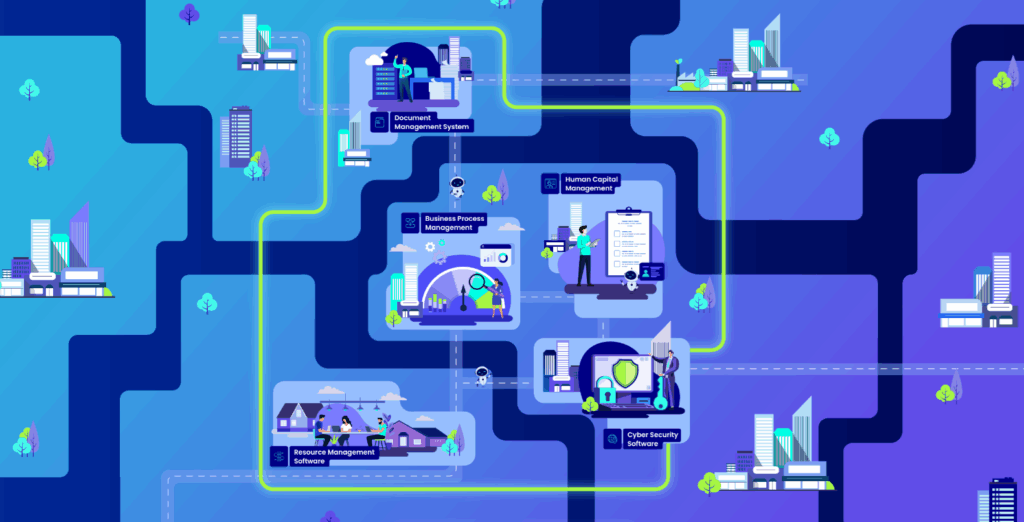
Welcome to Data City – the digital infrastructure for hybrid work

The Data City is our approach to a future-proof, seamless working environment. It combines all the key building blocks of the modern digital workplace into a powerful whole:

  • Document management (DMS/ECM)The central pillar of the Data City structured access to relevant information at all times, versioned, mobile and compliant. The DMS is an archive, administration center and knowledge hub at the same time – essential for smooth collaboration across locations and time zones.
  • Business Process Management (BPM): The backbone of process control. It plans, controls and optimizes digital workflows and ensures that everything works together – efficiently, transparently and automatically. Digital workflows and approvals relieve employees of routine tasks. This creates space for creative, responsible work and supports a culture of self-organization – an important component of trusting collaboration.
  • Resource management (workplace management): The Data City’s urban planning and logistics office. Workplaces, vehicles, rooms and even emergency accommodation are intelligently managed here – across locations, flexibly and user-friendly. Perfect for modern hybrid usage scenarios.
  • Cyber Security: The city wall of the Data City. It protects sensitive data and systems from attacks, especially via email – the most common gateway for cyberattacks. This means that all “residents” can move around the digital city safely – whether remotely, on the move or on site.

Data City: The key to true hybrid work capability

Every solution, every process and every application in the Data City is modular and coordinated – and together they add up to far more than the sum of their individual parts. The result is a seamless, scalable and secure digital infrastructure that combines leadership with trust, efficiency with flexibility and structure with freedom.

In the Data City, leadership is not replaced, but empowered. Smart dashboards and comprehensible processes provide managers with the necessary transparency without exerting control. In turn, teams experience digital working environments that empower them rather than restrict them – whether they are working from home, in the office or on the move.

The Data City is our answer to the requirements of a hybrid working world. It is not only a technological leader, but also a cultural pioneer – because it translates trust into digital practice and enables companies to live a modern working culture in a sustainable way.

Conclusion: Trust is not a risk – it is the prerequisite for success

Hybrid working not only places technical demands on companies – it also requires a radical rethink of management culture. The old idea that control equals productivity is no longer valid. On the contrary: control breeds mistrust, blocks personal responsibility and stifles innovation.

Trust, on the other hand, is the key to a resilient, creative and high-performance organization – especially in a digital and hybrid context. However, trust only works if it is supported by clear structures, smart tools and modern communication. It needs orientation instead of monitoring, digital support instead of control, leadership at eye level instead of micromanagement.

The dataglobal Group stands for precisely this change. We are not just a provider of digital solutions – we are a driving force for a new way of working that sees technology as an enabler. Our integrated digital workplace ecosystem combines document management, HR, workplace management and cyber security into an intelligent platform that makes hybrid collaboration simple, secure and efficient.

We help companies to establish a culture of trust – with digital tools that provide structure, simplify processes and at the same time enable freedom. In this way, we create space for what really matters: human connection, creative performance and sustainable productivity.

Experience with the dataglobal Group how modern leadership, trust and digital excellence work together – for a working world that is future-proof, human and efficient.

You might also be interested in

DATEV online interface in windream ECM

learn more

Merger forms new leading provider of HR software solutions in Germany

learn more

DMS as a strategic IT topic: Why you should act now as an IT decision-maker

learn more

Digital challenges in accounting: from paper invoices to a networked financial system

learn more