20.February.2025

Employee interview 02/2025: Janine Einig (P&C Manager)

Employee interview 02/2025: Janine Einig (P&C Manager)
Arrow
  • News

The interview series with employees of the dataglobal Group

How long have you been working for the dataglobal Group?

Since March 2024

What are your tasks as a P&C Manager?

As P&C Manager, I am responsible for the entire employee lifecycle – including contract management, HR support and the coordination of recruiting and onboarding processes. I also deal with issues such as remuneration and benefits and try to provide employees with the best possible support.

How did you get into HR and what do you find particularly exciting about the job?

By chance, I grew into a dual role in Sales and HR and quickly discovered my passion for it. I am particularly fascinated by the variety of tasks and the direct contact with people.

What makes your work in HR at dataglobal Group unique compared to your previous professional experience?

My work is special because it gives me the opportunity to actively contribute my own ideas and help shape a lot of things. Compared to my previous experiences, I don’t just have an operational role here, but can really leave my footprint – be it through new processes or new concepts.

How is the cooperation with your colleagues and the general atmosphere in the team and in the Group?

Cooperation is open and collegial, characterized by team spirit and mutual support. Everyone has the opportunity to make an active contribution.

How would you describe the corporate culture of the dataglobal Group in three words?

Courageous. Diverse. Dynamic

Thank you very much for the interview, Janine!

Apply now to the dataglobal Group

Are you interested in becoming part of the dataglobal Group and working with us to realize the vision of the Digital Workplace for our customers? We are always on the lookout for new talent, whether in software development or in other areas such as sales, consulting, etc.

Take a look at our current vacancies and see if there is a suitable position for you. We look forward to hearing from you!

You might also be interested in

DATEV online interface in windream ECM

learn more

Merger forms new leading provider of HR software solutions in Germany

learn more

DMS as a strategic IT topic: Why you should act now as an IT decision-maker

learn more

Digital challenges in accounting: from paper invoices to a networked financial system

learn more
13.February.2025

Employee interview 02/2024: Richein Bartsch (Software Developer)

Employee interview 02/2024: Richein Bartsch (Software Developer)
Arrow
  • News

The interview series with employees of the dataglobal Group

Richein Bartsch (Software Developer)

How long have you been working for the dataglobal Group?

Five strong years, I’ve been there since January 2019.

What exactly is your area of responsibility?

As a Backend Software Developer, I am currently responsible for working on our dg Cloud platform with our SaaS (Software-as-a-Service) team. I mainly focus on implementing features, bug fixes and improving our backend services (“microservices”/APIs).

Why did you choose the dataglobal Group as an employer? What particularly appeals to you about our products and services?

I chose the dataglobal Group because I have the feeling that the goals are always clear and that everyone in the various teams is working towards a common goal, even if the disciplines do not overlap. I think that in many very large IT companies, this common goal is very blurred between the individual teams. With us, it feels like one big team.

My main interest is the development of the SaaS platform and how we can integrate our existing products into this platform in a technically and commercially viable way.

How do you see the dg Group’s position in the business software market?

Our strength has always been to adapt to changes in the market and in technology, but not too quickly and not too slowly. I think we are very well positioned as we can offer both on-premise and SaaS solutions with our technology stacks.

What is particularly important to you in your job? Can the dg Group fulfill these requirements?

As a tech-savvy person, I like technical challenges and our goals always require solving complex technical problems. Otherwise, of course, it would get boring 😉 Otherwise, I really like the work culture and the flexibility.

How is the cooperation with colleagues and the general cooperation in the team and in the Group in general?

I think it’s great. It’s easy to talk to everyone, and the flexibility of ad hoc discussions and pair programming is very productive when it comes to development.

How would you describe the corporate culture of the dg Group in your own words?

Start-up culture without being a start-up, if that makes sense. Easy going, but serious and determined. The work flexibility is the same. I think it’s a great working atmosphere.

Would you recommend the dataglobal Group as an employer? Why?

In any case!


Thank you very much for the interview, Richein!

Apply now to the dataglobal Group

Are you interested in becoming part of the dataglobal Group and working with us to realize the vision of the Digital Workplace for our customers? We are always on the lookout for new talent, whether in software development or in other areas such as sales, consulting, etc.

Take a look at our current vacancies and see if there is a suitable position for you. We look forward to hearing from you!

You might also be interested in

DATEV online interface in windream ECM

learn more

Merger forms new leading provider of HR software solutions in Germany

learn more

DMS as a strategic IT topic: Why you should act now as an IT decision-maker

learn more

Digital challenges in accounting: from paper invoices to a networked financial system

learn more
12.February.2025

5 myths about the e-bill

5 myths about the e-bill
Arrow
  • News

Electronic invoicing has been mandatory in the B2B sector since January 2025 – an important step towards digitalization. The legal requirement underlines the increasing importance of e-invoicing for companies of all sizes. Nevertheless, misunderstandings and half-truths about the topic persist, preventing companies from taking advantage of the benefits of e-invoicing. In this blog post, we get to the bottom of the most common myths about e-invoicing and show why they are not true.

Myth 1: “Switching to e-billing is too expensive and time-consuming.”

Many companies fear that the implementation of e-invoices will incur high costs and involve a complex changeover process. However, this assumption is outdated.

Why this myth is not true

  • Modern software solutions are often affordable and scalable, making them suitable for small and medium-sized enterprises (SMEs).
  • Many providers offer cloud-based solutions that can be implemented without major IT investments.
  • The long-term benefits outweigh the initial costs: e-invoices save paper, printing and postage costs and significantly reduce the time spent on manual processes.
  • With the right preparation and an experienced partner, the changeover can even be completed in just a few weeks.

Myth 2: “E-invoices are insecure.”

Another common misconception is that digital invoices are susceptible to data leaks or manipulation. This makes many companies reluctant to implement electronic invoicing.

Why this myth is not true

  • E-invoices are generally more secure than paper invoices as they are protected with digital signatures, encryption technologies and authentication procedures.
  • The automatic documentation of all transactions makes it easier to detect manipulations.
  • Legal regulations, such as the EU directive on electronic invoicing, ensure that e-invoices meet high security standards.
  • Companies that rely on proven solutions can be sure that their sensitive data is well protected.

Myth 3: “E-invoices are only suitable for large companies.”

Many small and medium-sized companies believe that electronic invoices only make sense for large corporations, as they have extensive IT resources at their disposal.

Why this myth is not true

  • There are numerous solutions specifically for SMEs that are easy to use and cost-effective.
  • Cloud-based platforms do not require a complex infrastructure and can be easily integrated into existing processes.
  • Legal regulations on e-invoicing, such as those introduced in the EU or other regions, apply regardless of the size of the company.
  • By switching to digital invoices, smaller companies can also benefit from more efficient processes and competitive advantages.

Myth 4: “Paper invoices are legally more secure.”

Some companies cling to the idea that paper invoices are legally more secure due to physical receipts.

Why this myth is not true

  • Electronic invoices are legally recognized as long as they meet the legal requirements. These include, for example, a correct format, the authenticity of the origin and the integrity of the content.
  • Archiving e-invoices is often easier and more secure than storing paper documents, as digital documents cannot be lost or damaged.
  • With a certified system, companies are on the safe side and meet all legal requirements.

Myth 5: “Dealing with e-invoices is too complicated.”

There is often a perception that the process of processing and archiving e-invoices requires technical expertise and is difficult to implement.

Why this myth is not true

    • With user-friendly software, e-invoices can be processed and archived even more easily than paper invoices. Many systems offer automatic data extraction and archiving functions.

    • The archiving process is often simpler than with paper invoices: E-invoices can be saved at the touch of a button and organized with just a few clicks, without the need to sort or file physical documents.

    • Another advantage: automation minimizes errors and makes archiving faster and more efficient, which considerably simplifies the entire process.

Conclusion

The myths surrounding e-invoicing are based on outdated information or misunderstandings. In reality, electronic invoices offer numerous advantages: they save costs, are secure and efficient and contribute to sustainability. Whether you are a large company or a small business – switching to e-invoices is worthwhile for everyone.

So it’s time to put these prejudices aside and take advantage of the opportunities offered by the digital transformation. Companies that adopt e-invoicing at an early stage not only gain a competitive advantage, but are also well prepared for legal requirements.

So don’t let the myths put you off – the facts speak for themselves! Arrange a non-binding consultation with our experts now.

Submit your request now

You might also be interested in

DATEV online interface in windream ECM

learn more

Merger forms new leading provider of HR software solutions in Germany

learn more

DMS as a strategic IT topic: Why you should act now as an IT decision-maker

learn more

Digital challenges in accounting: from paper invoices to a networked financial system

learn more
12.February.2025

DMS specifications: How to find the right document management system

DMS specifications: How to find the right document management system
Arrow
  • News

A well thought-out specification sheet is the key to finding the right document management system for your company. It provides clarity about requirements, offers orientation in a complex market and makes it easier to select the right DMS software. In this article, you will learn what a professional specification sheet should contain and how to create one.

Why a specification sheet is indispensable in a DMS project

A detailed specification sheet is the cornerstone of a successful DMS project. It helps companies to select the document management system (DMS) that best suits their individual requirements. In a complex DMS market with countless providers and different functions, a specification sheet provides orientation and structure.

In this article, you will learn how to create a professional specification sheet for a DMS and which aspects you should consider.

The path to a paperless office

DMS software has the potential to completely rid your office of tedious paper and thus save you money. However, this decision also presents you with a significant challenge: you have to find the right system for your purposes – and that in a sea of providers and systems.

Would you like to find out more about the paperless office? Then we recommend our free white paper.

Mockup Whitepaper - Papierloses Büro - DE

What is a DMS?

DMS is the abbreviation of the word document management system. It is an electronic system for managing documents. DMS software makes it possible to capture, archive, categorize and process documents and link them together. Essentially, it supports the database-supported organization of documents using appropriate software.

The main task of a document management system is the digital and centralized archiving of all electronic documents that arise in an administration or a company. It accompanies the entire life cycle of a document – from its creation and processing through to final archiving or deletion.

A DMS system usually has a modular structure. Different modules cover specific task areas. These can be integrated or not, as required.

Tip: In our official DMS guide, you can find out everything you need to know about document management systems, including the benefits for your company, various checklists and best practices as well as a chapter on the “Document management system introduction concept”.

Mockup Whitepaper - Digital Workplace Guide - EN

DMS software as a collaboration tool

The DMS software is centralized. This means that all employees work with the same, correct data. This significantly improves cross-departmental collaboration. Workflows become more transparent and efficient for everyone involved.

Before the DMS specifications: Why you should initiate a separate DMS project

The search for the right document management system presents companies with numerous challenges. The introduction of such a system usually affects several departments and has far-reaching effects on internal processes and workflows.

It therefore makes sense to treat the search for a suitable document management system as a separate project. A dedicated DMS project creates clear structures, defines responsibilities and ensures that requirements are systematically recorded and prioritized. In addition, the structured project approach enables a well-founded market analysis and a transparent selection process in which different providers and solutions can be compared in a targeted manner.

Step by step to the DMS specifications

1. define goals and requirements

Before you draw up a specification sheet, you should be clear about the goals you are pursuing with the introduction of a document management system. Ask yourself:

  • What are the current challenges in document management?
  • Which processes would you like to optimize with the DMS?
  • What specific corporate goals are to be achieved through the introduction of the DMS?

These objectives form the basis for the requirements that you record in the specifications.

2. process-oriented description

The specifications should not only list functional requirements, but should also be based on the existing processes. Describe in detail how documents are currently processed, archived and forwarded. Identify weak points and consider how a DMS system can make these processes more efficient.

3. involve all departments

The introduction of a document management system usually affects the entire company. It is therefore important to involve all relevant departments and specialist areas in the creation of the specifications. This ensures that the DMS meets the requirements of all departments and that cross-departmental workflows are improved.

4. formulate requirements instead of solutions

Avoid specifying concrete technical solutions in the requirements specification. Instead, concentrate on the requirements. Potential providers can then offer more flexible solutions and better evaluate whether their software fits your needs.

5. consider technical and organizational requirements

In addition to the functional requirements, technical and organizational criteria should also be described in the specifications. These include

  • Required interfaces and connections to existing systems
  • Safety requirements
  • User administration and role rights
  • Service level agreements (SLAs) and support services

Specifications DMS template

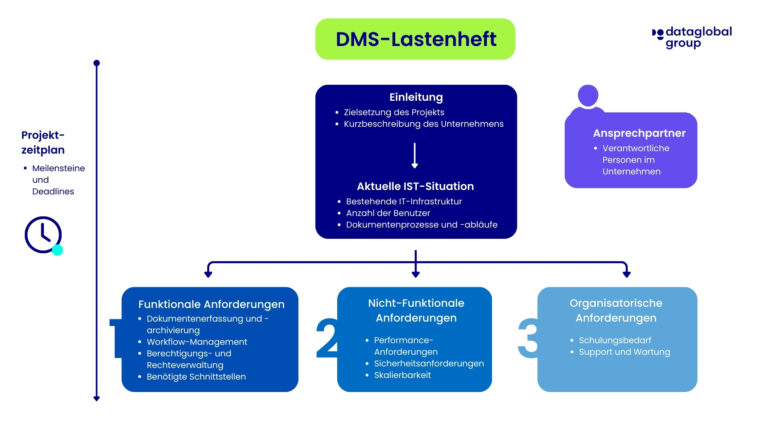
The following structure is an exemplary template for a DMS specification sheet that companies can use as a guide. As every company has different requirements and processes, the structure of the specifications can and should be customized accordingly.

Introduction:

  • Objective of the project
  • Brief description of the company

Current ACTUAL situation:

  • Existing IT infrastructure
  • Number of users
  • Document processes and workflows

Functional requirements:

  • Document capture and archiving
  • Workflow management
  • Authorization and rights management
  • Required interfaces

Non-functional requirements:

  • Performance requirements
  • Safety requirements
  • Scalability

Organizational requirements:

  • Training requirements
  • Support and maintenance

Project schedule:

  • Milestones and deadlines

Contact person:

  • Responsible persons in the company

Conclusion: The requirements specification as a success factor for DMS implementation

A professional specification sheet creates the basis for the successful introduction of a document management system. A structured DMS specification supports companies in selecting the right software and provides a valuable basis for the entire course of the project. It also serves as a helpful DMS specification template that is easy to understand for potential providers and internal project participants alike.

With a well thought-out concept for the introduction of a document management system, companies can optimize their processes sustainably and benefit from the advantages of digitization in the long term. Use the specifications not only as a template for selecting a provider, but also as a tool to systematically and successfully implement your DMS introduction.

Do you need help creating a specification sheet? We will be happy to advise you!

You might also be interested in

DATEV online interface in windream ECM

learn more

Merger forms new leading provider of HR software solutions in Germany

learn more

DMS as a strategic IT topic: Why you should act now as an IT decision-maker

learn more

Digital challenges in accounting: from paper invoices to a networked financial system

learn more