10.March.2025

Employee interview 06/2024: Pia Studzinski (trainee in Sales)

Employee interview 06/2024: Pia Studzinski (trainee in Sales)
Arrow
  • News

The interview series with employees of the dataglobal Group

Pia Studzinski (Trainee in Sales)

How long have you been working for the dataglobal Group?

Since 01.01.2024

What are your daily tasks and what do you focus on in your training?

I go through several departments in my training, but my focus is on Inside Sales. This includes the following activities:

  • Order processing
  • Quotation preparation
  • Audit
  • Processing e-mails
  • Working with SalesForce (CRM) and Site (ERP)
  • Amendment contracts
  • Process notices of termination and record them in the systems
  • Telephone reception

As I’ve only been in Sales so far, I can’t say anything about the other departments yet.

What do you particularly like about Sales at the dg Group?

I really enjoy customer contact and order processing.

I never thought I’d say this, but I’m particularly excited about the connection to math! I enjoy applying the things I learned at school and calculating amounts. I do this, for example, when creating maintenance tickets, the difference between maintenance and subscription and when entering an order in our “SITE” (ERP) system.

What is particularly important to you in training? Can the dg Group fulfill these requirements so far?

A trainee should be well received and also be allowed to take on responsibility. After just a short time, I was allowed to help out a lot and take on responsibility and, thanks to my nice colleagues and my trainer, I have fun at work every day – and you can even have breakfast or a snack in between! 😊

At the dataglobal Group, I also like the fact that I was immediately welcomed into the “family” and was even invited to the annual Christmas party before I started my apprenticeship.

I also find team building and communication very important, which the dg Group fully fulfills. I really like the fact that there are weekly meetings to clarify situations for everyone in the department and to discuss everything.

About once a month, there is also a meeting with all employees and the management to discuss a monthly review. There’s always something delicious to eat here too – and you can win me over with food anyway!😄

“A trainee should be well received and also be allowed to take on responsibility.”

Where do you see our goals in Sales? What challenges do we face?

A major goal at the moment is to convert as many customers as possible to subscription contracts, which of course poses challenges from time to time. We have to make a good case here and explain the benefits.

Another major goal is to analyze the monthly data in order to recognize how useful a campaign is, for example, and to react to it with changes if necessary.

How is the cooperation with colleagues and the general cooperation in the team and in the Group in general?

Cooperation is very good and everyone keeps an eye on ensuring that no one is put under pressure. If someone has too many tasks, the other person is happy to take on some of them.

How would you describe the corporate culture of the dg Group in your own words?

The dg Group has very nice employees and is an open, modern company.

Would you recommend the dataglobal Group as an employer? Why?

I would definitely recommend the dataglobal Group as a place to train or work. This is because of the points I have already mentioned:

  • Super employee/trainer
  • Modern and open culture
  • Promotes learning (you learn a lot of new things!)
  • Home office offers
  • Lots of communication
  • Delicious food once a month
  • Team events/team building (e.g. our summer party)
  • Flexible working hours
  • Beautiful office furnishings with plants


Thank you very much for the interview, Pia!

Apply now to the dataglobal Group

Are you interested in becoming part of the dataglobal Group and working with us to realize the vision of the Digital Workplace for our customers? We are always on the lookout for new talent, whether in software development or in other areas such as sales, consulting, etc.

Take a look at our current vacancies and see if there is a suitable position for you. We look forward to hearing from you!
You might also be interested in

DATEV online interface in windream ECM

learn more

Merger forms new leading provider of HR software solutions in Germany

learn more

DMS as a strategic IT topic: Why you should act now as an IT decision-maker

learn more

Digital challenges in accounting: from paper invoices to a networked financial system

learn more
10.March.2025

E-bill: What is the Growth Opportunities Act?

E-bill: What is the Growth Opportunities Act?
Arrow
  • News

What you need to know about the Growth Opportunities Act and e-billing.

The Growth Opportunities Act is a major initiative of the German government aimed at promoting economic growth, easing the burden on companies and citizens and driving forward the digital transformation. A central element of the Growth Opportunities Act is the mandatory introduction of e-billing.

What is the Growth Opportunity Act?

The “Act to Strengthen Growth Opportunities, Investment and Innovation as well as Tax Simplification and Tax Fairness” (Growth Opportunities Act for short) was passed by the Bundestag on November 17, 2023 and approved by the Bundesrat on March 22, 2024. It comprises a large number of measures that include tax and administrative changes to stimulate investment, reduce bureaucracy and strengthen the competitiveness of the German economy.

As part of the changes in the area of VAT, the European Commission is planning an electronic reporting system. The data collected through e-invoices should be able to be fed into the planned reporting system.

Main objectives of the Growth Opportunities Act at a glance

Reducing bureaucracy: Companies should be freed from administrative burdens and the processing of business transactions should be simplified.

Tax relief: The law provides for various tax reliefs to promote investment and innovation.

Strengthening competitiveness: Companies should become more competitive through more efficient processes and reduced bureaucracy.

Promotion of digitization: The mandatory e-bill is intended to modernize and digitize business processes.

What is an e-bill?

An e-invoice, or electronic invoice, is a digital form of invoice creation and transmission. In contrast to traditional paper invoices, the e-invoice is created and transmitted in a standardized electronic format that can be processed automatically by computer systems. This digital processing enables faster and more efficient invoicing and processing, reduces errors and saves costs. To ensure that everything works smoothly with the e-invoice and that a clean exchange can take place, the e-invoices must comply with the European standard EN 16931.


The technical requirements for the e-bill

The European standard for electronic invoicing EN-16931 defines a specific data structure that contains all the necessary information for invoicing, such as invoice number, invoice date, supplier data, customer data, service description, amounts and taxes. EN-16931 specifies the use of the XML data format to make the data structure clear and machine-readable. This enables seamless integration into existing ERP systems and other business software solutions. Although the standard specifies a specific data structure, it also allows for extensions to integrate industry-specific requirements or additional information.

The XRechnung as a technical standard

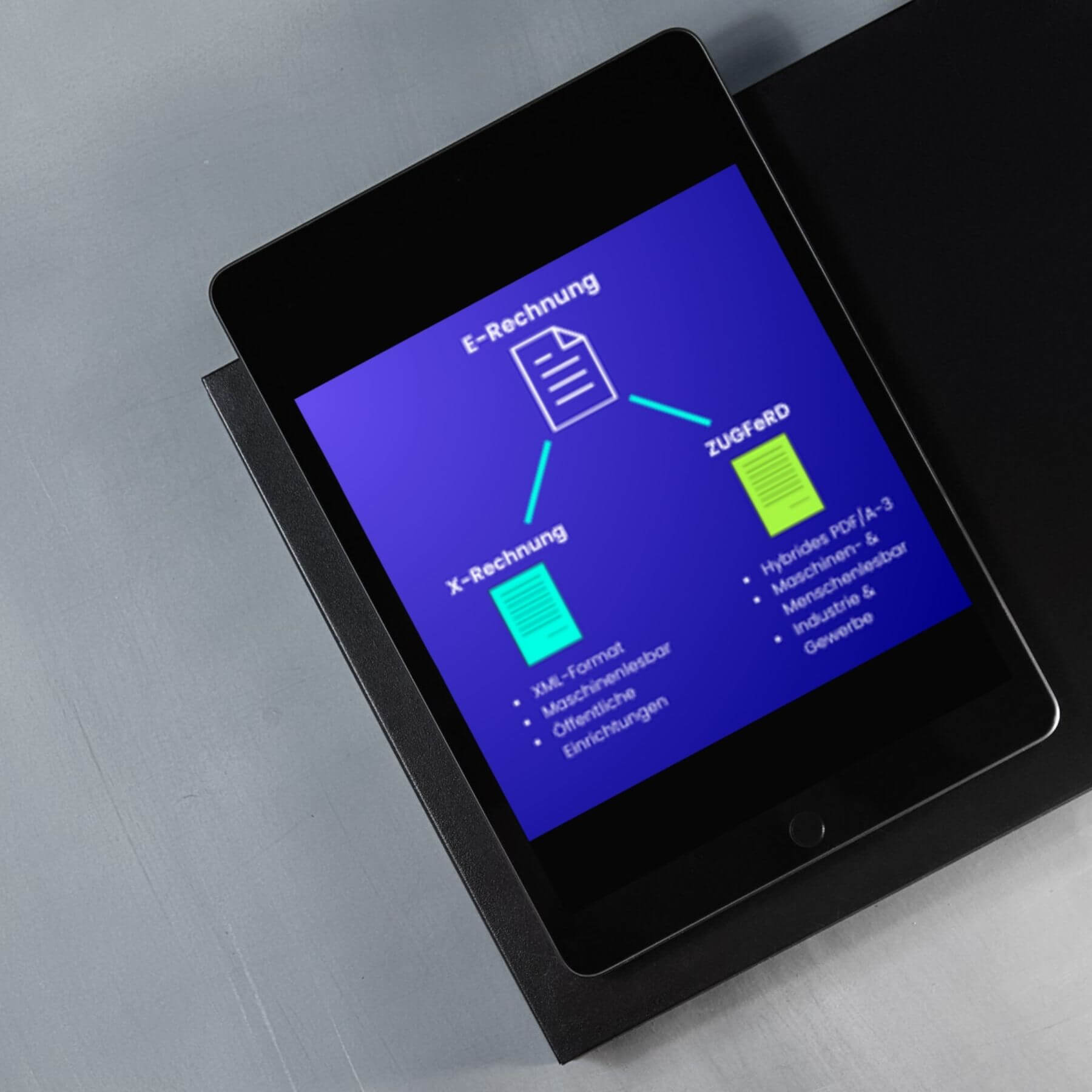
In Germany, on the basis of EN 16931, the XRechnung which has been mandatory for suppliers and service providers who issue invoices to public clients since November 27, 2020. The XRechnung contains all the necessary information in a clearly defined XML format. This format is only used for machine processing. However, the data set can be made readable for humans by using visualization programs.

ZUGFeRD as a hybrid solution

With ZUGFeRD (Central User Guide of the Forum for Electronic Invoicing Germany) is a hybrides invoice formatwhich is the machine-readable XML data format through a PDF file supplemented. This means that a human-readable file is directly included. The Compliance with legal requirements for electronic invoices is thereby guaranteed by ZUGFeRD.


The e-invoicing obligation from 2025

E-invoicing is already mandatory in the public sector. From 2025, mandatory e-invoicing will now also be gradually introduced for the B2B sector. The Growth Opportunities Act has set the following dates for the implementation of mandatory e-invoicing:

From January 01, 2028: The Germany-wide obligation to send e-invoices comes into force for all B2B companies.

From January 1, 2025: All German companies are obliged to be able to receive and evaluate e-invoices without prior consent. The creation and sending of e-invoices is not yet mandatory.

From January 1, 2027: All German companies that generate a turnover of more than 800,000 euros per year are obliged to send e-invoices.

Conclusion

The Growth Opportunities Act and the promotion of e-billing are important steps on the way to digitizing the economy. Companies should use the opportunities that arise to optimize their processes, reduce costs and operate more sustainably. The planned switch to electronic invoices is an essential part of this transformation process and offers a wide range of benefits that go far beyond mere cost savings.

Arrange a consultation now

You might also be interested in

DATEV online interface in windream ECM

learn more

Merger forms new leading provider of HR software solutions in Germany

learn more

DMS as a strategic IT topic: Why you should act now as an IT decision-maker

learn more

Digital challenges in accounting: from paper invoices to a networked financial system

learn more
07.March.2025

The 8 most common mistakes when introducing e-invoicing – and how to avoid them!

The 8 most common mistakes when introducing e-invoicing – and how to avoid them!
Arrow
  • News

From 2025, the mandatory introduction of e-invoicing in Germany will be implemented in stages. For companies, this is not only a legal requirement, but also offers the opportunity to modernize their invoicing processes and make them more efficient. But beware: there are numerous pitfalls on the road to digital invoicing that can make the transition more difficult. In addition to technical challenges, organizational and legal aspects are particularly crucial.

In this article, you will find out what mistakes companies often make when introducing e-invoicing – and how you can proactively avoid them. Regardless of whether you are at the beginning of the process or already in the middle of implementation: With these tips, you will master the switch to e-invoicing smoothly and benefit from all the advantages.

What you should know about the e-invoicing obligation in Germany

From January 1, 2025, the use of e-invoices in business transactions between companies will be mandatory. This requirement is based on an EU-wide directive that prescribes a standardized and machine-readable invoice format. The aim is to make the processing of invoices more efficient and legally compliant.

The EN 16931 standard format defines the structure of this invoice data. Companies are required to comply with these specifications in order to remain legally compliant and benefit from the advantages of digital invoicing processes.

Further information on the legal framework and practical tips can be found in our free guide to e-billing.

XRechnung and ZUGFeRD: The most important formats at a glance

In Germany, the XRechnung and ZUGFeRD formats play a central role in the implementation of e-invoicing. While XRechnung was primarily optimized for the public sector, ZUGFeRD is characterized by the combination of a PDF document and an integrated XML data structure. This hybrid format is particularly attractive for smaller companies, as it combines readability and machine processing.

Both formats ensure standardized and error-free data transfers, which significantly increases efficiency and reliability in the invoicing process.

The 8 most common mistakes when introducing e-invoicing – and how you can avoid them

1) Starting the changeover too late

The introduction of e-billing requires thorough preparation. If you postpone the changeover, you risk time pressure and errors. Start early so that you have enough time to adapt your processes and systems.

2) Old software versions not updated in time

Older ERP systems often do not meet the technical requirements of e-invoicing. Take the opportunity to modernize your software and benefit from functions such as XRechnung or ZUGFeRD.

3) Maintain manual processes

Processing invoices manually not only takes a lot of time, but is also prone to errors. To take full advantage of e-invoicing and comply with legal requirements, it is crucial to fully digitize your invoicing processes.

4) Neglect archiving

The audit-proof archiving of e-invoices is often underestimated. Yet it is a central component of compliance. Rely on an established document management system to archive your data securely and be able to access it at any time.

5) Choosing the wrong e-invoicing software

Choosing the right e-invoicing software is crucial for a successful transition – a solution that doesn’t fit your requirements, on the other hand, will lead to many unnecessary complications.

Our software offers you a tailor-made solution that integrates perfectly into your existing systems. With comprehensive functions, a user-friendly interface and the highest security standards, we support you in efficient, error-free and legally compliant invoice processing. Benefit from first-class support and flexible scalability to meet your future requirements.

Rely on our e-invoicing solution to optimize your invoicing processes in the long term and successfully shape the digital transformation.

6) Lack of process control

Even after the introduction of e-invoicing, you should continuously monitor your processes. Automated monitoring tools help to identify errors at an early stage and rectify them quickly.

7) Insufficient communication with business partners

Inform your partners in good time about the upcoming changeover. Close cooperation with suppliers and customers will ensure that the exchange of e-invoices runs smoothly.

8) No long-term optimization plan

The introduction of e-invoicing is the first step towards process digitization. Develop a strategy to continuously optimize your invoicing processes and use new technologies such as AI.

Use the e-bill as a driver for innovation

The introduction of mandatory e-invoicing enables companies to make their processes more efficient and future-proof in the long term. Those who plan in good time, avoid typical mistakes and rely on best practices can not only meet the legal requirements, but also achieve sustainable competitive advantages.

Introduction of e-billing with the dataglobal Group

Are you ready for the changeover? Our team will be happy to support you every step of the way – from planning to implementation. Our software solution for e-invoicing makes it easier for you to comply with legal standards and at the same time sets the course for the sustainable digitalization of your business. At the same time, we will be happy to assist you with our comprehensive range of consulting services.

Arrange a consultation now

You might also be interested in

DATEV online interface in windream ECM

learn more

Merger forms new leading provider of HR software solutions in Germany

learn more

DMS as a strategic IT topic: Why you should act now as an IT decision-maker

learn more

Digital challenges in accounting: from paper invoices to a networked financial system

learn more
07.March.2025

2025: What’s next for mandatory e-invoicing?

2025: What’s next for mandatory e-invoicing?
Arrow
  • News

Since 2023, electronic invoicing (e-invoicing) has been mandatory for companies in the public sector in Germany. However, the e-invoicing obligation, which initially applied to public clients and the B2G (business-to-government) sector, is now also being extended to the B2B sector. The Growth Opportunities Act, which will come into force from 2025, will further advance digital invoice processing and requires companies to make a comprehensive switch to digital processes.

What does the Growth Opportunities Act say?

The Growth Opportunities Act is a comprehensive legislative project of the German federal government that aims to promote digitalization in the economy and increase the efficiency of public and private administrative processes. It contains measures to encourage companies and public authorities to make greater use of digital technologies and reduce bureaucratic hurdles.

A central component of the law is the introduction and extension of the e-invoicing obligation, which initially applied to public clients and B2G and has now been extended to the B2B sector. This regulation obliges companies to transmit their invoices in a standardized electronic format (e.g. XRechnung or ZUGFeRD).

The aim of this measure is to simplify invoicing, reduce sources of error and cut administrative costs. In addition, the law ensures that all electronic invoices must be securely archived and stored for a specified period of time. This helps to increase transparency, traceability and compliance in business transactions. The Growth Opportunities Act thus marks an important step towards a modern, digitalized economy and public administration.

Official page on the Growth Opportunities Act

Important deadlines and requirements

  • 2025: From January 1, 2025, it will be mandatory for all B2B companies to receive and properly archive e-invoices. Companies must adapt their systems to process electronic invoices in a standardized format and archive them securely for the legally prescribed retention period.
  • End of 2026: At the end of December 31, 2026, the transitional regulation that previously allowed B2B companies to use paper invoices or other electronic formats will end. From this date, these companies must only issue and receive e-invoices in the prescribed format.
  • End of 2027: An extended transition period for B2B companies with a turnover of less than 800,000 euros in the previous year expires on December 31, 2027. These companies, which were previously able to send invoices in paper or other formats, must also switch to e-invoices by then.

2028: From January 1, 2028, the complete obligation to use e-invoices will apply to all B2B companies. From this date, all invoices must be issued, received and archived exclusively digitally and in a standardized format.

What does this mean for companies?

The introduction of mandatory e-invoicing as part of the Growth Opportunities Act brings far-reaching changes for B2B companies. The switch to digital invoice processing is not only a legal requirement, but also offers numerous advantages. But what exactly do B2B companies need to do to meet the requirements?

Integration of a digital invoice format: B2B companies must issue their invoices in XRechnung or ZUGFeRD format. This means that the invoices must be machine-readable to enable easy processing by recipients. Companies should therefore introduce appropriate software solutions that support these formats.

Automating invoice processing: Manual invoice processing is becoming increasingly inefficient and error-prone. By introducing software solutions for digital invoice processing, companies can increase efficiency and minimize the error rate. Automated workflows help to simplify invoicing and make the entire process faster and smoother.

Document archiving and retention obligations: The requirements for document archiving are also tightened by the e-invoicing obligation. All electronic invoices must be securely archived and stored for a period of ten years. Companies must ensure that their archiving systems meet these requirements.

What comes next?

The e-invoicing obligation and digital invoice processing are just one part of the comprehensive digital transformation that B2B companies in particular will be facing in the coming years. However, the Growth Opportunities Act is not the end of the journey, but rather a milestone on the road to a paperless, digital future.

  • Integration of artificial intelligence (AI): Companies are likely to increasingly rely on AI-supported solutions to further improve the efficiency of invoicing. These technologies can not only create and send invoices automatically, but also recognize discrepancies in invoices and make suggestions for correcting errors.
  • Further European harmonization: In the coming years, greater harmonization of digital invoice formats can be expected at European level. B2B companies that operate internationally will have to adapt to uniform standards and new requirements.

Conclusion: What will happen with e-billing from 2025?

The introduction of mandatory e-invoicing through the Growth Opportunities Act is a significant step towards digital and efficient administration. B2B companies that have not yet started the changeover must act quickly in order to meet the requirements of the law. However, the digitization of invoice processing not only offers the opportunity to meet legal requirements, but also to optimize processes, save costs and increase efficiency.

At the turn of the year 2024/2025, the B2B sector is facing a number of new challenges, but also opportunities. The implementation of e-invoicing and the automation of invoice processing are key steps on the path to a digital future. Those who prepare well now will not only meet the legal requirements, but will also benefit from the advantages of digitalization.

Arrange a consultation

You might also be interested in

DATEV online interface in windream ECM

learn more

Merger forms new leading provider of HR software solutions in Germany

learn more

DMS as a strategic IT topic: Why you should act now as an IT decision-maker

learn more

Digital challenges in accounting: from paper invoices to a networked financial system

learn more