14.August.2025

Digital challenges in accounting: from paper invoices to a networked financial system

Digital challenges in accounting: from paper invoices to a networked financial system
Arrow
  • News

Digitization of accounting, automation of invoice processing, compliance in digital accounting – on paper, this all sounds like efficiency, clarity and real-time transparency. In reality, however, day-to-day work in many finance and controlling departments looks very different: Invoices trickle in as PDFs by email, approvals happen “on demand” in the hallway, budget requests arrive as Excel files attached. Instead of analyses and strategic management, there is a lot of searching, queries and checking.

That’s what we call it: Fragmentopolis.
Here, controllers and accountants spend 30% of their working time searching for data alone. And while they navigate the paper and file jungle, they miss out on discounts, reports arrive too late and decisions are based more on gut feeling than on reliable figures.

Everyday life in Fragmentopolis – typical pain points

Whether in SMEs or international corporations, the problems often look frighteningly similar. Fragmentopolis is not a place on the map, but the state of a finance department that is stuck in analog thinking and manual processes despite modern software.

1st Excel version chaos
Almost everyone in accounting knows the infamous file: “Report_final_neu_version7_mehrfinal.xlsx”. It appears in several email inboxes, is stored in different folders and nobody knows which version is actually up to date. Changes are made in parallel, data is overwritten and in the end everything has to be painstakingly merged again.

2. loss of time due to manual data search
Instead of finding invoices or receipts with just a few clicks, a small odyssey often begins: in the mailbox, in the file folder, in the ERP system. Reminder emails are written or phone calls are made for every missing approval. The invoice approval process not only drags on for days, but also repeatedly interrupts the actual work.

3. high susceptibility to errors
If data has to be entered manually several times, the risk of transposed figures, double entries or the accidental deletion of important information increases. Outdated data is also common: one colleague works with yesterday’s data, while others have already entered new values.

4. missed opportunities
Every delay in invoice processing can cost money. Discount periods go unused, budgets are distributed on the basis of uncertain forecasts and valuable insights from the data remain hidden because there is simply no time for in-depth analyses.

5. lack of transparency
Who checked the invoice? Which cost center approved it? And how long has the document been in the process? In many departments, there is no immediate answer to these questions. Instead of clear workflows, there is uncertainty and the overview is only restored after several phone calls or e-mail chains.

The result:
Finance and controlling teams spend a large part of their time reacting rather than actively shaping. Operational hecticness replaces strategic clarity, and the aspiration to make data-based decisions all too often turns into pure damage limitation in day-to-day business.

Causes of the digital challenges

If you take a closer look at the typical pain points in finance & controlling, you will quickly realize that they do not arise by chance, but often have deeper structural reasons. Even companies that already use modern software fail to overcome the same hurdles, but in digital form.

1. lack of automation and inadequate workflows

Many finance departments still work as they did ten or fifteen years ago, except that the paper folders have now been replaced by PDF files. Invoices are entered manually, approvals are obtained by email and receipts are stored in different folders. Although there are often software solutions such as an ERP or a DMS, without automated workflows, the benefits are very limited.
Example: Although an invoice is scanned digitally, it still has to be manually assigned to the correct cost center. Each missing approval triggers another email chain.

2. system breaks and complicated tools

Another key problem is media and system discontinuities. If invoice processing, the ERP system and the document management system do not talk to each other, employees have to enter the same data multiple times or constantly switch between programs. This not only costs time, but also increases the risk of errors. It becomes particularly critical when individual tools are so complicated to use that users are reluctant to use them or do not use them at all. In practice, this leads to modern functions going unused.

3. costs and culture

Digitization is not free, neither financially nor in terms of internal resources. In addition to license and implementation costs, it takes time for training, conversions and adjustments. The team often lacks the necessary know-how to use new tools effectively. There is also a cultural factor: resistance to change. Many employees are used to the previous system and initially perceive new processes as an additional burden. The common refrain “We’ve always done it this way” is one of the biggest, but underestimated, obstacles on the path to digitalized processes.

4. flood of data without analysis capability

In a digitalized financial world, the volume of data has increased enormously. But more data does not automatically mean more insights. Without business intelligence integration and real-time dashboards, controlling is flying blind. Although all relevant information is often available somewhere in the system, it is not linked, not up-to-date or not prepared in a form that enables quick decisions to be made. The result: reports are based on outdated values, forecasts lose their informative value and management makes decisions without a reliable data basis.

According to the Bitkom Digital Office Index 2024:

  • 100% of German companies now use at least one digital office solution
  • 39 % work predominantly paperless, 20 % still heavily paper-based.
  • 35% want to increase their digitalization investments.

The way out: getting started in Data City

Data City stands for a networked, digital financial system that brings back clarity and controllability – modular, connectable and compatible with your existing software.

How to get out of Fragmentopolis:

  • Digital invoice receipt with OCR recognition instead of manual typing
  • Automatic workflows for approvals, escalations and archiving
  • Real-time dashboards for precise, up-to-date key figures
  • Audit-proof archiving for compliance and audits
  • Flexible integration with ERP, CRM and other tools

The result: fewer searches, more taxes. Fewer queries, more decisions.

Checklist: Do you still live in Fragmentopolis?

Answer honestly:

  • Do you regularly search for invoices or receipts?
  • There are at least three different versions of the same Excel sheet?
  • Are approvals often given by e-mail or verbally?
  • Are you waiting for data when you need to create a report?
  • Dashboards with live figures? Not a chance.

If you have answered “yes” more than twice – it’s high time to move to Data City.

Whitepaper

Do you want to move away from paper chaos and towards controllable finance processes? Download our free white paper ‘How to achieve clear figures and real decisions with less paper chaos’ now. Get your roadmap from Fragmentopolis to the Data City!

Conclusion

Digital transformation in accounting is no longer a topic for the future. Today, it determines whether finance departments merely manage or actively shape. Manual processes, isolated tools and a lack of transparency lead to errors, lost time and missed opportunities. At the same time, examples such as Data City show that it is possible to achieve clear figures, quick decisions and resilient processes without having to throw existing systems overboard. The key is to openly recognize the typical pain points, implement targeted automation and integration and thus switch from reaction mode to a controlling role. Those who dare to take this step leave fragmentopolis and gain not only efficiency, but also the basis for sustainable corporate success.

You might also be interested in

DATEV online interface in windream ECM

learn more

Merger forms new leading provider of HR software solutions in Germany

learn more

DMS as a strategic IT topic: Why you should act now as an IT decision-maker

learn more

Does hybrid work promote inequality in the company?

learn more
07.August.2025

Does hybrid work promote inequality in the company?

Does hybrid work promote inequality in the company?
Arrow
  • News

Hybrid working models are the new normal. They are considered modern, agile and seemingly inclusive. But behind the façade of flexibility and freedom lurks a critical question: does hybrid working inadvertently promote new forms of inequality? While many companies are happy about increased productivity, important aspects such as equal opportunities, visibility and fairness could be jeopardized.

Flexibility as a promise – but for whom?

Hybrid working has rapidly established itself since the pandemic. Employees can decide for themselves whether they want to work from the office, from home or on the move, which is a real benefit for many. Numerous studies prove this: Flexibility not only increases productivity, but also employee satisfaction and emotional loyalty to the company.

However, not everyone is benefiting from this change to the same extent. In many organizations, there is a new, often unnoticed power imbalance between physical presence in the office and team members working remotely. Those who are regularly on site are more likely to be seen, heard more often and remain more visible to managers. Many people who predominantly work remotely lack this visibility when working from home. This has concrete consequences for their ability to exert influence, their sense of belonging and, not least, their career opportunities.

This makes it clear that hybrid work is only progress for everyone if companies take targeted countermeasures and see the disadvantages of remote work not as collateral damage, but as a challenge that can be shaped.

Invisible in the Zoom call – visible in the office

Who gets seen, gets promoted? The new face of inequality

The path to promotion is often not just about performance, but about visibility. Presence in the office means access to:

  • Spontaneous discussions with the management level
  • Quick decisions and informal coordination
  • Social capital: networks, trust, influence

Employees working from home, on the other hand, are physically absent and run the risk of being mentally blanked out. Even in video calls, it’s harder to get involved or pick up on nuances.

As a result, those who mainly work remotely often find it harder to be heard and therefore harder to move up the career ladder.

Isolation instead of integration

  • 23% feel isolated when working from home.
  • Half say: Fewer friendships in the company.
  • 51% of managers feel alienated from their team.
  • According to 31% of respondents, team communication is suffering.

Source: Bath, J., Brauchle, S. Effectiveness of mandatory office quotas in hybrid working models.Z. Arb. Wiss. 79, 234-249 (2025). https://doi.org/10.1007/s41449-025-00459-4

The silent split in the company

In hybrid meetings, 37% feel excluded.

  • Asynchronous communication is on the rise – but also brings risks.
  • Around 40% do not feel well informed when working from home.

Source: Bath, J., Brauchle, S. Effectiveness of mandatory office quotas in hybrid working models.Z. Arb. Wiss. 79, 234-249 (2025). https://doi.org/10.1007/s41449-025-00459-4

The path to more fairness in hybrid structures

Hybrid work must be shaped

The good news first: hybrid working can be absolutely fair, productive and sustainable if companies don’t leave it to chance, but manage it strategically and consciously. For hybrid models to work in the long term, it takes more than home office regulations and video calls. What is really needed is a systematic approach that takes both technical and cultural dimensions into account.

✅ Rethinking leadership: hybrid teams need new leadership skills

One of the biggest challenges in hybrid working models is managing virtual teams. Traditional management styles often fall short here. Leadership in hybrid teams means promoting employees equally, actively involving them and supporting them individually, regardless of where they work. Trusting leadership at a distance, regular feedback and empathetic communication are crucial for success.

✅ Enable targeted visibility in the home office

A key problem in many companies is the lack of visibility in the home office. Those who work remotely often have less access to informal discussions and spontaneous decision-making processes, which can hinder careers in the long term. Transparent feedback cycles, traceable performance measurement and digital project tools are essential to avoid these remote work disadvantages. This actively promotes equal opportunities in the home office.

✅ Actively shaping digital corporate culture

Hybrid working models are not only changing the workplace, but also the way we work together. Traditional forms of team culture do not automatically work digitally. New, creative formats are therefore needed to promote digital corporate culture and team cohesion, such as virtual coffee breaks, joint retrospectives or collaborative whiteboards. These formats not only strengthen collaboration, but also create emotional closeness despite physical distance.

✅ HR digitization as the basis for fair structures

HR digitalization in the context of hybrid work is the key to standardizing processes, systematically supporting employees and making decisions transparent. From digital onboarding and automated absence planning to smart resource management: the right tools enable all team members to be treated equally, whether in the office or working from home.

✅ Standardized processes for more fairness and transparency

To prevent inequality through hybrid work, companies need to review their structures. Meetings, information flows and decision-making channels must not only benefit employees who are physically present. Uniform standards and digital documentation ensure that no knowledge is lost and no one is left out.

Free white paper for HR professionals: How to introduce hybrid work fairly

Do you want to ensure that hybrid working in your company creates opportunities, not inequality?

Then download our free white paper from the dataglobal Group now!

Specially developed for HR managers, our guide is a practical guide:

  • How to plan hybrid work strategically and organize it fairly
  • How to guide employees through change and uncertainty
  • What role communication, leadership and corporate culture play
  • How modern tools such as vysoft’s resource management can effectively support your HR processes

This white paper is a must-read for all HR managers who want to actively shape the future of work

Conclusion: Hybrid working needs more than WLAN and Zoom

Hybrid work is far more than just a workplace trend, it is a genuine cultural change. However, this change brings with it challenges that companies need to actively address. Without a clear strategy, structural disadvantages quickly arise, especially for employees working remotely.

Remote work disadvantages such as a lack of visibility, a lack of informal exchange or more difficult access to decision-making processes are real and should not be underestimated. Visibility in the home office remains one of the key issues when it comes to fair performance appraisals and career opportunities. Those who are not present are often unconsciously less noticed – this is a critical insight for any modern management and corporate culture.

It is therefore essential to specifically promote equal opportunities when working from home. This starts with clear communication and extends to transparent decision-making processes and digitally supported HR processes. This is precisely where hybrid working models come into play in the HR context: they must be designed in such a way that all employees have the same development opportunities and chances to participate, whether on site or remotely.

Companies that want to successfully establish hybrid working cannot avoid HR digitalization for hybrid working. Tools such as vysoft’s resource management, structured onboarding processes and virtual feedback systems help to manage hybrid teams efficiently and integrate them fairly. Leadership in hybrid teams requires new skills: Empathy, digital communication skills and the ability to create closeness despite distance.

If hybrid working is implemented correctly, it can be a real lever for greater flexibility, productivity and employee satisfaction. However, if it is left to chance, there is a long-term risk of inequality due to hybrid work, demotivation and a silent division of the workforce. Now is the time to set the right course for a fair, digital and sustainable world of work.

You might also be interested in

DATEV online interface in windream ECM

learn more

Merger forms new leading provider of HR software solutions in Germany

learn more

DMS as a strategic IT topic: Why you should act now as an IT decision-maker

learn more

Digital challenges in accounting: from paper invoices to a networked financial system

learn more
23.June.2025

Employee interview 06/2025: Michael Schreib

Employee interview 06/2025: Michael Schreib
Arrow
  • News

The interview series with employees of the dataglobal Group

Tell us a bit about your career. How did you get into the field of data analytics and development?

I first came into contact with data analytics and AI during my studies in “Management and Technology” at the Technical University of Munich. I came fully into contact with the topic of data analytics at a previous job in a large corporation, where I was able to experience how important it is to obtain reliable information from the growing amount of available data. The topic of artificial intelligence has also stayed with me ever since. At dataglobal Munich, I was responsible for our extended reporting solutions right from the start. These are Power BI evaluations that we offer our customers in addition to our resource management products. With the increasing focus on generative AI, the topic of artificial intelligence has moved even more into the spotlight. I am therefore all the more pleased to be able to work with my colleagues on how we can integrate AI into our products in a meaningful and customer-oriented way.

What does your typical working day look like?

My working day starts with our daily meeting, where we discuss current development topics and support cases as a team. I then dedicate myself to development tasks, exchange ideas with colleagues or support and advise customers on our extended reporting solutions. Technological research and tasks as part of my role as a change agent are also regularly part of my day-to-day work.

What was the last project you worked on that particularly challenged or inspired you?

I find the integration of AI into our products particularly inspiring. We are working intensively on how we can use generative AI in such a way that it creates real added value for our customers. As the topic is so new and dynamic, there are always new, exciting use cases to explore, such as AI-supported product wikis, support chatbots or the development of an AI assistant that allows our resource management solutions to be used simply by voice or text input.

You are currently working on the AI assistant in our resource management solution – how did this come about? What was the trigger for the project?

How can we use this technology to offer our customers real benefits? An early prototype of a support bot showed potential, but was not yet “smart” enough. This gave rise to the idea of an assistant that could not only provide general information, but also take on specific tasks in our solutions, such as providing booking information or directly booking resources such as workstations. Our vision: a solution that is so intuitive to use that users can simply talk or chat with it, for example on their way to work.

What further developments or new use cases do you see for the AI assistant in our solution?

We are currently working on making the AI assistant production-ready for all core processes of our resource management solutions. We have already made particularly good progress with the desk sharing solution, but there is still a lot to do. We see great potential in the long term: users will soon be able to easily book workstations, parking spaces or meeting rooms by voice or chat, find out which colleagues are in the office with them today and no longer have to search the product wikis for a solution themselves when they have questions about the application. AI could also make the administration of our solutions much easier in future, for example when setting up new room or parking space plans.


Thank you very much for the interview, Michael!

Apply now to the dataglobal Group

Are you interested in becoming part of the dataglobal Group and working with us to realize the vision of the Digital Workplace for our customers? We are always on the lookout for new talent, whether in software development or in other areas such as sales, consulting, etc.

Take a look at our current vacancies and see if there is a suitable position for you. We look forward to hearing from you!

You might also be interested in

DATEV online interface in windream ECM

learn more

Merger forms new leading provider of HR software solutions in Germany

learn more

DMS as a strategic IT topic: Why you should act now as an IT decision-maker

learn more

Digital challenges in accounting: from paper invoices to a networked financial system

learn more
19.June.2025

Hybrid working: Control mania vs. trust

Hybrid working: Control mania vs. trust
Arrow
  • News

Hybrid working is here to stay. What once began as an emergency solution has long since become an expectation – of employees, but also of an increasingly digitalized economy. However, many companies are struggling to come to terms with this new working reality. The question of leadership in particular is at the heart of the transformation: control or trust – which understanding of leadership is best suited to the “new” reality in the workplace?

The dataglobal Group is clearly positioned here: modern work culture only works on the basis of trust. As a driving force for the digital workplace of the future, we not only provide software, but also a holistic ecosystem that makes hybrid work intelligent, secure and productive.

The control reflex: when old thought patterns get in the way of the new world of work

The hybrid working world is putting established management patterns to a fundamental test. Many managers who have been socialized for years or decades in a presence culture experience the loss of control through home office and mobile working as a threat. What used to be suggested by “visible productivity” at one’s own desk – punctual arrival, long presence, apparent busyness – suddenly disappears in the hybrid model. What remains is uncertainty: Is work really being done? Is the team available? Is nothing getting lost?

This uncertainty leads many managers to take compensatory measures – with the aim of regaining control. The methods range from time recording and attendance tools to status tracking in chat programs (“green dot”) and software that creates screenshots, measures click counts or even monitors keystrokes. Even the seemingly harmless “just checking to see if you’re online” is part of this culture of digital mistrust.

Micromanagement in a digital guise is the result: instead of placing trust in the self-organization and target responsibility of their teams, some managers fall into tight control mechanisms. Daily mandatory updates, seamless reporting obligations and hourly deadlines are no exception, but widespread practice – and they convey one thing above all: mistrust.

The figures paint a clear picture: Only 2% of employees state that they work more productively under direct supervision (IW Cologne, 2024). What’s more, digital monitoring creates stress, damages motivation and leads to internal resignation in the medium term. Trust, on the other hand, has a performance-enhancing effect – 60% of employees say they are more motivated to work if they are allowed to act independently and feel that their superiors trust them.

The control reflex is also psychologically problematic: leadership based on monitoring fails to recognize the needs of hybrid employees. Above all, they want clarity about tasks and goals, reliable communication and an environment in which they can act independently. If there is a lack of trust, hybrid models remain technically feasible – but they lose quality, innovation and sustainability.

Hybrid leadership needs a paradigm shift. Away from the illusion that productivity can be measured by visibility. Towards management based on goals, results and trust. This requires new skills – but also the right tools to ensure transparency, communication and commitment without constant monitoring.

Trust: The productive driver of hybrid teams

Trust is not a soft skill. In a world in which employees are no longer visible in the office on a daily basis, trust is becoming the central basis for effective collaboration. This is not just about interpersonal well-being, but also about very concrete economic effects: According to Accenture, employees in trust-based hybrid companies not only remain healthier and more productive, but also more loyal – an invaluable advantage in an increasingly competitive labor market.

The Fraunhofer IAO also comes to a clear conclusion in its studies: trust, combined with clear communication and digital tools, increases the ability to innovate and adapt – two success factors that hybrid organizations urgently need.

Managers who are prepared to share responsibility and give room for autonomy create psychological security – a state in which people are prepared to give their best, communicate mistakes openly and show initiative. This security is the foundation of productive, creative and resilient teams – especially in decentralized, virtual structures.

Trust does not mean arbitrariness. On the contrary: if you want trust, you have to offer a framework, clarity and reliability. Goals must be transparent, roles clear and processes comprehensible. Then there is no need for complete control, just regular dialog and a common understanding of what is to be achieved.

And this is precisely where the strength of a modern, digital working environment comes into play: it creates the necessary structure to combine trust with transparency – without control. An integrated digital workplace, such as that offered by the dataglobal Group, creates a framework in which employees can access relevant information at any time, manage processes independently and collaborate with colleagues across locations. This makes control superfluous – because orientation, overview and clarity are provided digitally.

What hybrid work really needs: clarity, digital structure and flexibility

Trust does not mean laissez-faire. A trust-based work culture only works if it is built on a stable foundation – and this foundation consists of clarity, structure and flexibility. Many companies make the mistake of confusing trust with “just do it” – but the opposite is true: trust is only effective when goals are clear, processes are transparent and expectations are unambiguous.

If you want to lead in a hybrid setup, you have to actively shape – not control. In concrete terms, this means

  • Goal orientation instead of time recording: instead of tracking working time to the minute, it’s all about results. With target systems such as OKR (Objectives & Key Results) or SMART targets, the focus is on impact and contribution – regardless of the location or time of day at which work is carried out.
  • Transparent communication: regular check-ins, virtual team updates and structured feedback loops ensure that everyone is in the picture – without constant monitoring. Communication thus becomes a bridge between trust and responsibility.
  • Digital infrastructure: Hybrid teams need systems that not only work, but also actively enable collaboration. A strong digital workplace ensures that all information, documents and applications are secure, up-to-date and available regardless of location – from draft contracts to project status.
  • Psychological safety: Employees need to know that they can ask questions, contribute ideas and make mistakes – without negative consequences. This is the only way to create a culture of learning and personal responsibility in which innovation can flourish.
  • Clear rules for accessibility and boundaries: Hybrid working must not slip into an “always on” mentality. That’s why we need defined availability times, break regulations and digital rest periods. Only those who can switch off will remain productive in the long term.

This clearly shows that trust alone is not enough. A supportive system is needed that guarantees orientation, security and productive collaboration – without lapsing into control.

This is precisely where the dataglobal Group comes in. With our holistic, AI-supported digital workplace ecosystem, we deliver not just software, but an intelligent, integrated platform that combines clarity, efficiency and flexibility. Our solutions combine document management (ECM), workplace management and cyber security to create a seamless digital working environment designed specifically for hybrid teams. This creates a digital backbone that gives employees security, managers transparency and companies the agility they need to not only assert trust, but to make it effective in everyday life.

The dataglobal Group’s answer: an intelligent, integrated digital workplace

The dataglobal Group offers more than just software – we are shaping a new reality of working: intelligent, integrated, intuitive. Our AI-supported digital workplace ecosystem creates the framework in which hybrid collaboration is not only possible, but measurably more successful. Trust is not created here by chance, but through transparency, security and a digital structure that enables orientation and freedom at the same time.

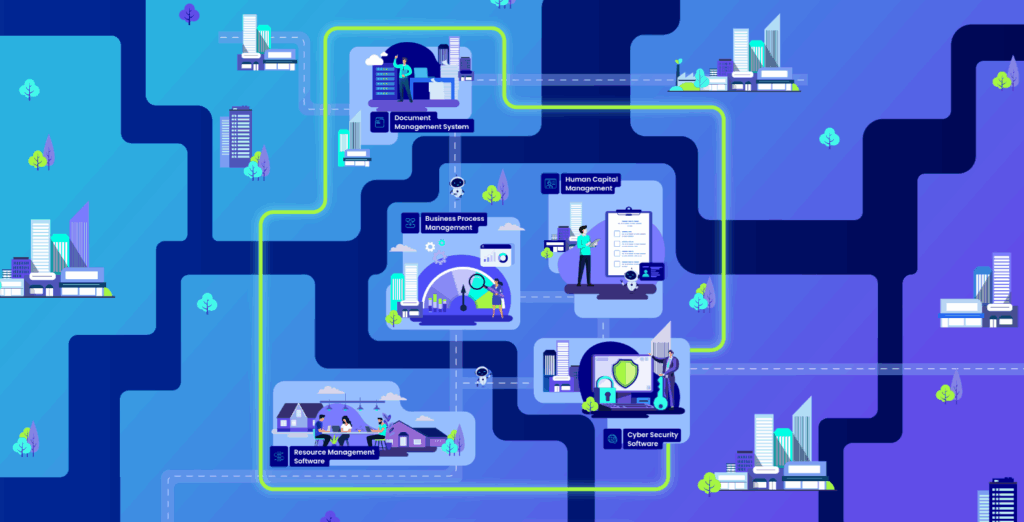
Welcome to Data City – the digital infrastructure for hybrid work

The Data City is our approach to a future-proof, seamless working environment. It combines all the key building blocks of the modern digital workplace into a powerful whole:

  • Document management (DMS/ECM)The central pillar of the Data City – structured access to relevant information at all times, versioned, mobile and compliant. The DMS is an archive, administration center and knowledge hub at the same time – essential for smooth collaboration across locations and time zones.
  • Business Process Management (BPM): The backbone of process control. It plans, controls and optimizes digital workflows and ensures that everything works together – efficiently, transparently and automatically. Digital workflows and approvals relieve employees of routine tasks. This creates space for creative, responsible work and supports a culture of self-organization – an important component of trusting collaboration.
  • Resource management (workplace management): The Data City’s urban planning and logistics office. Workplaces, vehicles, rooms and even emergency accommodation are intelligently managed here – across locations, flexibly and user-friendly. Perfect for modern hybrid usage scenarios.
  • Cyber Security: The city wall of the Data City. It protects sensitive data and systems from attacks, especially via email – the most common gateway for cyberattacks. This means that all “residents” can move around the digital city safely – whether remotely, on the move or on site.

Data City: The key to true hybrid work capability

Every solution, every process and every application in the Data City is modular and coordinated – and together they add up to far more than the sum of their individual parts. The result is a seamless, scalable and secure digital infrastructure that combines leadership with trust, efficiency with flexibility and structure with freedom.

In the Data City, leadership is not replaced, but empowered. Smart dashboards and comprehensible processes provide managers with the necessary transparency without exerting control. In turn, teams experience digital working environments that empower them rather than restrict them – whether they are working from home, in the office or on the move.

The Data City is our answer to the requirements of a hybrid working world. It is not only a technological leader, but also a cultural pioneer – because it translates trust into digital practice and enables companies to live a modern working culture in a sustainable way.

Conclusion: Trust is not a risk – it is the prerequisite for success

Hybrid working not only places technical demands on companies – it also requires a radical rethink of management culture. The old idea that control equals productivity is no longer valid. On the contrary: control breeds mistrust, blocks personal responsibility and stifles innovation.

Trust, on the other hand, is the key to a resilient, creative and high-performance organization – especially in a digital and hybrid context. However, trust only works if it is supported by clear structures, smart tools and modern communication. It needs orientation instead of monitoring, digital support instead of control, leadership at eye level instead of micromanagement.

The dataglobal Group stands for precisely this change. We are not just a provider of digital solutions – we are a driving force for a new way of working that sees technology as an enabler. Our integrated digital workplace ecosystem combines document management, HR, workplace management and cyber security into an intelligent platform that makes hybrid collaboration simple, secure and efficient.

We help companies to establish a culture of trust – with digital tools that provide structure, simplify processes and at the same time enable freedom. In this way, we create space for what really matters: human connection, creative performance and sustainable productivity.

Experience with the dataglobal Group how modern leadership, trust and digital excellence work together – for a working world that is future-proof, human and efficient.

You might also be interested in

DATEV online interface in windream ECM

learn more

Merger forms new leading provider of HR software solutions in Germany

learn more

DMS as a strategic IT topic: Why you should act now as an IT decision-maker

learn more

Digital challenges in accounting: from paper invoices to a networked financial system

learn more