30.March.2025

Accounting Summit 2025

Accounting Summit 2025
Arrow
  • Events
  • News

The dataglobal Group at the Accounting Summit 2025

On September 3 and 4, 2025 it’s that time again: The Accounting Summit in Düsseldorf brings together decision-makers and digitization experts from finance and accounting – and the dataglobal Group is right in the middle of it!

Digitalization that really works

Digitization in accounting often brings more frustration than progress – if each department uses its own tools, gaps, media disruptions and unnecessary complexity arise. We take a different approach:
With our platform, we create a consistent, networked ecosystem that truly simplifies and accelerates processes.

Your Data City: How modern accounting works

The dataglobal Group’s Data City focuses on one thing: information is available where it is needed – without searching, without detours. For finance teams, this means

  • All documents, contracts, approvals and communication are organized centrally.
  • Approval processes are automated, structured and traceable.
  • Relevant information is available at all times – whether in the office, working from home or on the move.
  • Collaboration with other departments (e.g. Purchasing or HR) is seamless and without media disruptions.

Connect. Collaborate. Protect.

  • Connect – All systems, data and processes are intelligently interconnected.
  • Collaborate – Teams work together efficiently because everyone is on the same page.
  • Protect – your financial data is archived securely, in compliance with auditing requirements and GDPR-compliant at all times.

Let’s connect in Düsseldorf!

Visit us at the Accounting Summit 2025
September 3-4, 2025 | Areal Böhler, Düsseldorf
Hall 1 | Booth L14

Get to know us and discover how we can work together to make your financial processes smarter.

You might also be interested in

DATEV online interface in windream ECM

learn more

Merger forms new leading provider of HR software solutions in Germany

learn more

DMS as a strategic IT topic: Why you should act now as an IT decision-maker

learn more

Digital challenges in accounting: from paper invoices to a networked financial system

learn more
10.March.2025

Digital invoice processing: 6 advantages you should know about

Digital invoice processing: 6 advantages you should know about
Arrow
  • News

The way in which companies create, send and process invoices has changed considerably in recent years as a result of technological progress. With the introduction of mandatory e-invoicing, another significant change is imminent that will affect many companies. In this article, we highlight the benefits of digital invoice processing and explain why it makes sense to switch to digital processes at an early stage.

What does the e-invoicing obligation mean and when does it come into force?

The e-invoicing obligation brings fundamental changes to invoicing processes and drives digitization in Germany. From January 1, 2025, a phased introduction will begin to prepare companies for the transition to structured, electronic invoice formats.

From January 1, 2025: First phase of mandatory e-invoicing

From this date, all companies in Germany are obliged to be able to receive and evaluate electronic invoices – regardless of whether they operate in the public or private sector. Invoices must be in a structured format such as the XRechnung standard or the ZUGFeRD format.
Companies that provide goods or services to public clients are also required to issue and send invoices in electronic form. Paper and PDF invoices are no longer recognized in this context.

From January 1, 2027: mandatory shipping for larger companies

In the second phase of the e-invoicing obligation, all German companies with an annual turnover of more than 800,000 euros must send their invoices electronically. This applies to the B2B sector.

From January 1, 2028: E-invoicing mandatory for all companies

From 2028, the obligation to send invoices electronically will apply to all German B2B companies expanded. This means that the manual issuing and sending of invoices will finally be replaced by digital processes.

The advantages of digital invoice processing

The introduction of digital invoicing processes represents an important milestone in the modern business world. It involves far more than just switching from paper to electronic formats and brings with it a wide range of benefits that promote efficiency, transparency and sustainability. The key aspects of digital invoice processing and their far-reaching effects are examined in more detail below:

1. time and cost savings

Digital invoice processing reduces the effort involved in manual processes:

  • No more manual data entry: invoices are automatically imported into the accounting system, minimizing human error.
  • Faster processing: invoices can be validated and processed in just a few seconds.
  • Lower paper and printing costs: companies save money on printing, postage and archiving.

It is estimated that the automation of invoicing processes can save up to 60-80% of the costs associated with conventional processes.

2. improved compliance and legal certainty

Thanks to its standardized formats, the e-bill meets all legal requirements. Companies benefit from this through:

  • Legally compliant archiving: Digital invoices can be stored in accordance with the requirements of the GoBD (principles for the proper management and storage of books, records and documents in electronic form).
  • Tax transparency: Automatic validation of invoice data ensures that tax regulations are complied with.

In addition, electronic processing makes audits by tax authorities more efficient and transparent.

3. sustainability and environmental friendliness

Digital invoice processing significantly reduces paper consumption, which not only saves costs but also protects the environment:

  • Conserving resources: less paper, printer ink and energy consumption.
  • CO₂ reduction: elimination of physical postal routes and logistics costs.

By switching to digital processes, companies can improve their ecological footprint and position themselves as sustainable organizations.

4. increased transparency and traceability

Digital systems allow all invoices to be tracked in real time. The advantages include

Simple audits: Audits by internal or external bodies can be carried out faster and more precisely.

Better overview: All invoices are stored centrally and can be easily searched.

Tracking and status tracking: Companies know exactly when an invoice has been sent, received and paid.

5. scalability and integration

Digital invoicing processes can be easily adapted to the needs of a growing company.

Flexibility with volume fluctuations: Whether a small company processes 50 invoices a month or a large corporation processes several thousand – digital systems are scalable.

6. minimization of errors and fraud risks

Connection to other systems: Digital invoice platforms can be integrated with ERP and accounting systems, which optimizes the entire workflow.

Manual invoice processing is prone to errors such as incorrect amounts, duplicate invoices or transmission errors. Digital solutions offer considerable advantages here:

Protection against fraud: Unique identifiers and encrypted transmission paths significantly reduce the risk of invoice fraud.

Automated validation: systems check invoices for formal and content-related correctness.

Conclusion: An investment in the future

The introduction of mandatory e-invoicing is not only a legal challenge, but also an opportunity for companies to modernize their internal processes. The benefits of digital invoice processing – from cost savings and sustainability to compliance and scalability – far outweigh the initial conversion costs.

Investing in digital technologies at an early stage is therefore a decisive step towards remaining competitive and benefiting from efficiency gains. Companies that use e-invoicing as an opportunity to optimize their invoicing processes not only ensure legally compliant processing, but also create the basis for a future-proof organization.

Arrange a consultation now

You might also be interested in

DATEV online interface in windream ECM

learn more

Merger forms new leading provider of HR software solutions in Germany

learn more

DMS as a strategic IT topic: Why you should act now as an IT decision-maker

learn more

Digital challenges in accounting: from paper invoices to a networked financial system

learn more
10.March.2025

E-bill: What is the Growth Opportunities Act?

E-bill: What is the Growth Opportunities Act?
Arrow
  • News

What you need to know about the Growth Opportunities Act and e-billing.

The Growth Opportunities Act is a major initiative of the German government aimed at promoting economic growth, easing the burden on companies and citizens and driving forward the digital transformation. A central element of the Growth Opportunities Act is the mandatory introduction of e-billing.

What is the Growth Opportunity Act?

The “Act to Strengthen Growth Opportunities, Investment and Innovation as well as Tax Simplification and Tax Fairness” (Growth Opportunities Act for short) was passed by the Bundestag on November 17, 2023 and approved by the Bundesrat on March 22, 2024. It comprises a large number of measures that include tax and administrative changes to stimulate investment, reduce bureaucracy and strengthen the competitiveness of the German economy.

As part of the changes in the area of VAT, the European Commission is planning an electronic reporting system. The data collected through e-invoices should be able to be fed into the planned reporting system.

Main objectives of the Growth Opportunities Act at a glance

Reducing bureaucracy: Companies should be freed from administrative burdens and the processing of business transactions should be simplified.

Tax relief: The law provides for various tax reliefs to promote investment and innovation.

Strengthening competitiveness: Companies should become more competitive through more efficient processes and reduced bureaucracy.

Promotion of digitization: The mandatory e-bill is intended to modernize and digitize business processes.

What is an e-bill?

An e-invoice, or electronic invoice, is a digital form of invoice creation and transmission. In contrast to traditional paper invoices, the e-invoice is created and transmitted in a standardized electronic format that can be processed automatically by computer systems. This digital processing enables faster and more efficient invoicing and processing, reduces errors and saves costs. To ensure that everything works smoothly with the e-invoice and that a clean exchange can take place, the e-invoices must comply with the European standard EN 16931.


The technical requirements for the e-bill

The European standard for electronic invoicing EN-16931 defines a specific data structure that contains all the necessary information for invoicing, such as invoice number, invoice date, supplier data, customer data, service description, amounts and taxes. EN-16931 specifies the use of the XML data format to make the data structure clear and machine-readable. This enables seamless integration into existing ERP systems and other business software solutions. Although the standard specifies a specific data structure, it also allows for extensions to integrate industry-specific requirements or additional information.

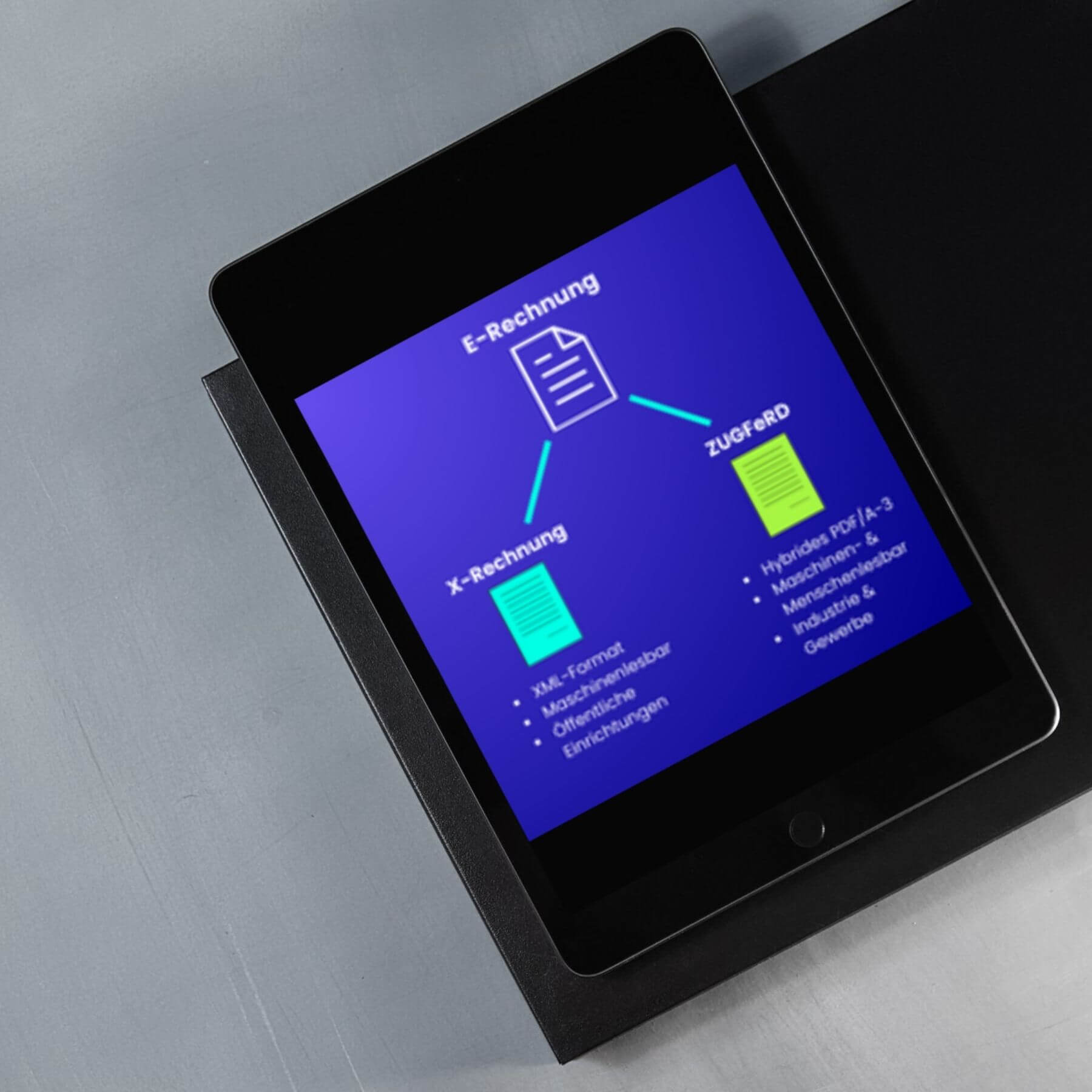
The XRechnung as a technical standard

In Germany, on the basis of EN 16931, the XRechnung which has been mandatory for suppliers and service providers who issue invoices to public clients since November 27, 2020. The XRechnung contains all the necessary information in a clearly defined XML format. This format is only used for machine processing. However, the data set can be made readable for humans by using visualization programs.

ZUGFeRD as a hybrid solution

With ZUGFeRD (Central User Guide of the Forum for Electronic Invoicing Germany) is a hybrides invoice formatwhich is the machine-readable XML data format through a PDF file supplemented. This means that a human-readable file is directly included. The Compliance with legal requirements for electronic invoices is thereby guaranteed by ZUGFeRD.


The e-invoicing obligation from 2025

E-invoicing is already mandatory in the public sector. From 2025, mandatory e-invoicing will now also be gradually introduced for the B2B sector. The Growth Opportunities Act has set the following dates for the implementation of mandatory e-invoicing:

From January 01, 2028: The Germany-wide obligation to send e-invoices comes into force for all B2B companies.

From January 1, 2025: All German companies are obliged to be able to receive and evaluate e-invoices without prior consent. The creation and sending of e-invoices is not yet mandatory.

From January 1, 2027: All German companies that generate a turnover of more than 800,000 euros per year are obliged to send e-invoices.

Conclusion

The Growth Opportunities Act and the promotion of e-billing are important steps on the way to digitizing the economy. Companies should use the opportunities that arise to optimize their processes, reduce costs and operate more sustainably. The planned switch to electronic invoices is an essential part of this transformation process and offers a wide range of benefits that go far beyond mere cost savings.

Arrange a consultation now

You might also be interested in

DATEV online interface in windream ECM

learn more

Merger forms new leading provider of HR software solutions in Germany

learn more

DMS as a strategic IT topic: Why you should act now as an IT decision-maker

learn more

Digital challenges in accounting: from paper invoices to a networked financial system

learn more
04.March.2025

E-invoicing for small businesses: How to master the changeover

E-invoicing for small businesses: How to master the changeover
Arrow
  • News

Mandatory e-invoicing for small businesses – what you need to know now!

From 2025, the receipt of electronic invoices will be mandatory in Germany, even for small businesses. We have prepared the most important information for you here.

What is the e-bill? Why is it being made mandatory?

An e-invoice is an electronically created and transmitted invoice in a structured format (e.g. ZUGFeRD, XRechnung) that is machine-readable and legally standardized. It differs from a PDF in that it can be processed automatically.

The e-billing obligation has several objectives:

  • Promoting digitalization and more efficient business processes
  • Combating VAT fraud through better control
  • Implementation of EU directives (2014/55/EU) for standardization
  • Reduction of time and costs for companies
  • Adapting to the international trend to facilitate global trade

Small businesses are also affected by the e-invoicing obligation, even if they are exempt from many other tax obligations. In future, they must be able to receive and archive electronic invoices and also create and send them from 2030.

E-invoicing obligation for SMEs: Important facts for small businesses

From 2025, all companies in Germany, including small businesses, will be obliged to use electronic invoices. This means that from January 2025, you must be able to both receive and properly archive electronic invoices.

The sending of e-invoices will also become mandatory in subsequent years: The original plan was to implement the changes in 2028. However, on November 5, 2024, the EU Council decided to postpone the start date to July 1, 2030.

Important for the transition

Companies and self-employed persons who do not prepare for the introduction of e-invoicing in good time run the risk of losing tax advantages or even being subject to penalties. Timely adaptation to the new requirements is therefore crucial. Targeted preparation is the key to avoiding problems and ensuring a smooth transition.

However, the introduction of suitable e-invoicing software and the adaptation of internal processes are not only crucial in order to meet legal requirements. They also help to increase efficiency and transparency in invoicing processes. Companies that do not take these steps early on could be excluded from the benefits of digital invoice processing, such as faster payment processing and a reduced error rate.

Timely action is crucial

The switch to e-invoicing in 2025 will require adjustments to existing processes and systems. Companies should introduce suitable software solutions at an early stage in order to meet the legal requirements and ensure smooth integration.

In this context, e-invoicing software not only facilitates compliance with regulations, but also offers advantages such as faster payments, reduced susceptibility to errors and better traceability.

Digital invoice management with e-invoicing from dataglobal Group

The dataglobal Group’s e-invoicing solution enables you to manage invoices easily, quickly and securely. Our software extracts the contents of your invoices, checks them automatically and forwards them to standardized workflows. This provides you with a clear overview of all relevant data so that invoice verification is just as convenient as with conventional invoices. Of course, the solution also offers audit-proof archiving.

Small business e-invoicing software: Digitize your invoice management

The switch to e-invoicing represents an important milestone in the digitalization of your business processes. Regardless of whether you have previously worked with paper invoices or digital formats such as PDF: With the dataglobal Group solution, you can automatically validate, read and prepare all invoices for further processing, securely and efficiently.

In addition to meeting the legal requirements, which will become stricter from 2025, e-invoicing helps your company to position itself for the future. It is an important building block for the successful digital transformation of your company.

Switch to e-billing now – we support you with our advice!

Switching to e-invoicing can be a challenge, especially if you are a small business owner who is not yet familiar with digital invoicing processes. We will be happy to help you make the switch in an uncomplicated and efficient manner. Our team of experts will advise you on choosing the right software, help you with implementation and ensure that your systems are fully aligned with the requirements of the e-invoicing obligation.

Take advantage of our consulting services and send us your inquiry conveniently using the contact form. We will support you with customized solutions so that you can successfully master the changeover and benefit from the advantages of digital invoice processing.

Arrange a consultation now

You might also be interested in

DATEV online interface in windream ECM

learn more

Merger forms new leading provider of HR software solutions in Germany

learn more

DMS as a strategic IT topic: Why you should act now as an IT decision-maker

learn more

Digital challenges in accounting: from paper invoices to a networked financial system

learn more